The predators that hunted Australopithecus and other early hominins included large eagles, leopards, sabre-toothed and "false sabre-toothed" cats, giant hyenas and crocodiles. The evidence is physical: talon punctures in the Taung Child's eye sockets, two leopard-canine holes in a juvenile skull from Swartkrans, and crocodile bite marks on leg and foot bones from Olduvai Gorge.
In 1970, the South African palaeontologist Bob Brain noticed two small round holes in the back of a juvenile hominin skullcap from Swartkrans cave, catalogued as SK 54. He compared them with a fossil leopard jaw from the same deposit. The lower canines fitted the holes almost exactly, about 33 millimetres apart.
The child, a young Paranthropus robustus, had been seized by the head and probably dragged into a tree above the cave entrance, as leopards do today. Its remains fell into the cave below. That find changed how scientists read South African cave sites, and it frames the story of the predators that hunted Australopithecus and its relatives.
Why predators hunted Australopithecus
Australopithecus stood about 1 to 1.5 metres tall and weighed roughly 30–45 kilograms. It walked upright but could not run fast, had no large canines, and left no evidence of weapons. Species such as Au. afarensis (Lucy's species) and Au. africanus lived between about 3.9 and 2 million years ago in landscapes full of large carnivores.
Living primates show what that means. In the Taï Forest of Côte d'Ivoire, leopards kill chimpanzees. Crowned eagles take monkeys that weigh several times more than the bird. Baboons fall to leopards, lions and hyenas. In their 2005 book Man the Hunted, Donna Hart and Robert Sussman argued that early hominins faced similar pressure, and that predation shaped human evolution as much as hunting did.
Reading the bones: who collected them?
For decades, the bone piles in South African caves such as Sterkfontein, Swartkrans and Makapansgat were read as evidence that australopiths were hunters. Raymond Dart argued in the 1950s that they used bones, teeth and horns as weapons, an idea he called the "osteodontokeratic" culture.
Brain tested this with taphonomy, the study of how bones end up where they are found. He compared the fossils with modern bone piles made by leopards, hyenas, porcupines and people. His 1981 book, The Hunters or the Hunted?, concluded that many South African hominin fossils were collected by carnivores. The caves were often carnivore lairs or lay beneath leopard feeding trees, not hominin homes.
The Taung Child and the eagle
The Taung Child, found in 1924, was the first Australopithecus ever described. It died at about three years old, perhaps 2.8 million years ago.
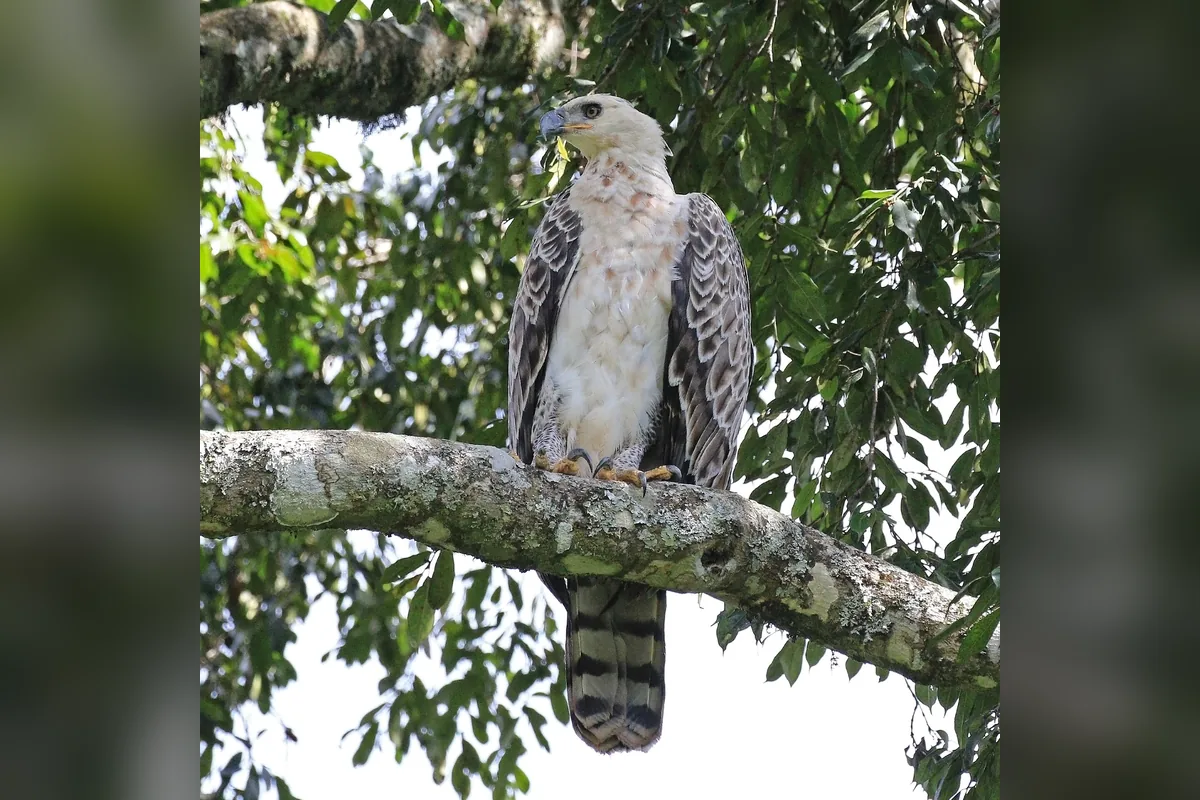
In 1995, Lee Berger and Ron Clarke pointed out that the animals found with it were mostly small: monkeys, hyraxes, tortoises and bird eggshell. That looked like the debris beneath a large eagle's nest, not a carnivore lair. In 2006, Berger identified punctures and broken bone in the floor of both eye sockets. Studies of crowned eagle kills in the Taï Forest, led by Scott McGraw, showed the same damage on monkey skulls: the eagle's talons pierce the eye sockets as it grips the head.
The likely killer was a bird very like the modern crowned eagle (Stephanoaetus coronatus), striking from above. Not everyone accepts every detail, but the eagle explanation is now widely supported.
| Predator | What it was | Evidence |
|---|---|---|
| Crowned eagle-type raptor | A powerful forest eagle that still hunts primates | Taung Child eye-socket damage; nest-like fauna |
| Leopard (Panthera pardus) | Big cat that caches prey in trees | Canine holes in SK 54, Swartkrans |
| Dinofelis | Leopard-to-jaguar-sized "false sabre-tooth" | Found in the same cave deposits; role debated |
| Megantereon and Homotherium | True sabre-toothed cats | Common in hominin-bearing sites |
| Giant hyenas | Pachycrocuta and the long-legged Chasmaporthetes | Bone-crushing and carcass competition |
| Crocodiles | Large river and lake predators | Bite marks on OH 8 and OH 35, Olduvai |
Leopards in the cave
SK 54 is the clearest case of leopard predation. Its two holes match leopard lower canines in spacing and shape. Leopards today drag kills into trees to keep them from lions and hyenas, and at Swartkrans trees probably grew around the cave openings, as they do in the region now. Bones dropped from them would collect in the cave below.
SK 54 belongs to Paranthropus, a robust relative of Australopithecus (see Paranthropus vs Australopithecus). The lesson applies to both: small hominins were a regular part of a big cat's diet.
Sabre-tooths and the "false sabre-tooth"
Dinofelis was a stocky cat with flattened, dagger-like canines, roughly the size of a jaguar. Brain suggested it may have specialised in primates, including hominins, because its remains turn up in the same South African deposits. The idea is hard to test, and most researchers treat it as possible rather than shown.
True sabre-toothed cats, Megantereon and Homotherium, also shared these landscapes. They probably targeted larger prey, but a lone australopith would have been an easy kill. Giant hyenas competed for carcasses and could kill as well as scavenge.
Crocodiles at Olduvai
The danger was not only on land. At Olduvai Gorge in Tanzania, about 1.8 million years ago, a hominin foot (OH 8) and a lower leg (OH 35) carry tooth marks. In 2012, Jackson Njau and Robert Blumenschine identified many of them as crocodile bites. A large horned crocodile from the same deposits was named Crocodylus anthropophagus, "human-eating crocodile", in 2010.
These Olduvai fossils probably belong to early Homo rather than Australopithecus. They still show what any hominin faced when it came to drink at a lake or river edge.
How early hominins stayed alive
Several features of australopith life make sense as defences:
- Climbing. Long arms and curved fingers in Au. afarensis suggest they still climbed, perhaps to sleep in trees at night, as chimpanzees do.
- Groups. Living in groups adds eyes and ears, and makes mobbing a predator possible.
- Vigilance. Standing upright gives a better view over tall grass, one of several proposed advantages of bipedalism (see why humans started walking upright).
From prey to predator
At Swartkrans, the balance seems to shift over time. In later layers, around 1 million years ago, Brain and Andrew Sillen found burnt bones that they interpreted as evidence of controlled fire, published in 1988. Fire would have helped keep predators away at night. That interpretation is debated, but it fits a broader change: with early Homo, larger brains, stone tools and eventually fire, hominins moved from regular prey towards predator.
Why it matters
We spent millions of years as prey. That pressure probably shaped how early hominins lived: in groups, alert, near trees, and avoiding the riskiest places at the riskiest times. It is a useful correction to the old "man the hunter" story. To see where Australopithecus sits on the human line, explore the interactive family tree or compare early Homo species.
See where the vulnerable australopiths sit near the base of our family tree.
Explore the family tree →Predators That Hunted Australopithecus FAQ
What animals hunted Australopithecus?
Large eagles, leopards, sabre-toothed cats, the false sabre-tooth Dinofelis, giant hyenas and crocodiles. Their tooth and talon marks appear on hominin fossils from South Africa and East Africa.
What killed the Taung Child?
Most likely a large eagle similar to the modern crowned eagle. Punctures and broken bone in both eye sockets match the damage these eagles cause when they kill monkeys today.
What is the SK 54 skull?
SK 54 is a juvenile Paranthropus robustus skullcap from Swartkrans cave, South Africa. Two holes in the back match the lower canines of a leopard, which probably carried the child into a tree above the cave.
Were early humans hunters or hunted?
Both, at different times. Australopithecus was mainly prey. Later Homo species, with stone tools, larger brains and eventually fire, increasingly became predators themselves.
- Brain, C. K. (1981). The Hunters or the Hunted? An Introduction to African Cave Taphonomy. University of Chicago Press.
- Berger, L. R. & Clarke, R. J. (1995). 'Eagle involvement in accumulation of the Taung child fauna.' Journal of Human Evolution 29: 275–299. doi.org
- Berger, L. R. (2006). 'Brief communication: predatory bird damage to the Taung type-skull of Australopithecus africanus Dart 1925.' American Journal of Physical Anthropology 131: 166–168. doi.org
- Njau, J. K. & Blumenschine, R. J. (2012). 'Crocodylian and mammalian carnivore feeding traces on hominid fossils from FLK 22 and FLK NN 3, Plio-Pleistocene, Olduvai Gorge, Tanzania.' Journal of Human Evolution 63: 408–417. doi.org