Habitual bipedalism—walking on two legs—is the earliest trait separating hominins from apes, emerging 6–7 million years ago. Before large brains, before tools, our ancestors stood up. Fossils from Sahelanthropus to Lucy show a gradual transition to upright walking, while anatomical signatures like the forward foramen magnum and S-curved spine reveal the hidden costs and benefits of life on two legs.
For millions of years, our ape-like ancestors moved on all fours, knuckle-walking through African forests much like chimpanzees and gorillas do today. Then, somewhere between 7 and 6 million years ago, something shifted. Some of them began to stand and walk upright on two legs—a change so profound that it defines the entire hominin lineage. Why did humans start walking upright? The answer rewrites what we thought we knew about human origins.
Bipedalism is often misunderstood as a response to open grasslands or a prerequisite for tool use and big brains. In truth, it emerged long before either arrived on the evolutionary scene. It was the first step—literally—that made us human. Understanding this transition reveals not just how our ancestors moved, but why the human body carries the marks of that ancient choice: our curved spines, our narrow pelves, our knees that bend inward, and our arched feet.
| Anatomy | Apes (quadrupedal) | Humans (bipedal) |
|---|---|---|
| Foramen magnum position | Rear of skull; body leans forward | Beneath skull; head balances upright |
| Spine shape | Slight C-curve; weight goes through arms and legs | S-curve with lumbar and cervical curves; balances trunk over legs |
| Pelvis shape | Long, narrow, rectangular; optimized for arm support | Short, bowl-shaped; supports upright posture and organs |
| Femur angle | Straight; legs splayed outward | Valgus (inward angled); knees track under body |
| Foot and big toe | Opposable big toe for grasping branches | Arched foot; big toe aligned for forward propulsion |
| Hands during travel | Weight-bearing; used for locomotion | Free to carry, grasp, manipulate, and gesture |
What Bipedalism Actually Means
Bipedalism is more than just standing on two legs—it is a complete reorganization of the skeleton, joints, and muscles to move efficiently upright. Walking on two legs requires precise balance and a chain of anatomical refinements. The spine must curve in an S-shape to keep the body's center of gravity over the feet. The pelvis narrows and reshapes to support the organs and anchor the muscles that swing the legs forward. The femur angles inward—a feature called valgus—so the knees track directly beneath the body rather than splaying outward. The feet develop arches and the big toe loses its opposability, aligning instead to push off the ground during each stride.
This is not a quick fix, but a wholesale engineering redesign. The hominin skeleton carries the signature of this transition in every bone. The price was steep: a curved spine prone to lower-back pain, a narrow pelvis that makes childbirth dangerously difficult, and legs prone to varicose veins. Yet the benefits—freed hands, greater endurance, and a new way of seeing the world—proved worth the cost.
The Fossil Timeline of Upright Walking
Fossils reveal bipedalism's slow emergence across millions of years. Sahelanthropus tchadensis — the "Toumaï" skull (TM 266) from Chad, dated to roughly 7 million years ago — shows one of the earliest hints: its foramen magnum—the hole where the spinal cord exits the skull—sits farther forward than in apes, suggesting the head was carried more upright. Yet debate surrounds this fossil; critics argue the positioning could reflect other factors, not necessarily bipedalism.
Orrorin tugenensis — "Millennium Man," found in Kenya around 6 million years ago — offers clearer evidence. Its thighbone (femur) displays the valgus angle and other features consistent with habitual bipedalism, though Orrorin may have retained significant tree-climbing ability. The most startling discovery came with Ardipithecus ramidus, or "Ardi," a 4.4-million-year-old skeleton from Ethiopia that shocked paleoanthropologists in 2009. Ardi had a pelvis and limb proportions suited to upright walking, yet its foot retained a grasping big toe adapted for climbing. Most surprising: Ardi lived in woodland, not open savanna—overturning the old idea that bipedalism arose when forests turned to grass.
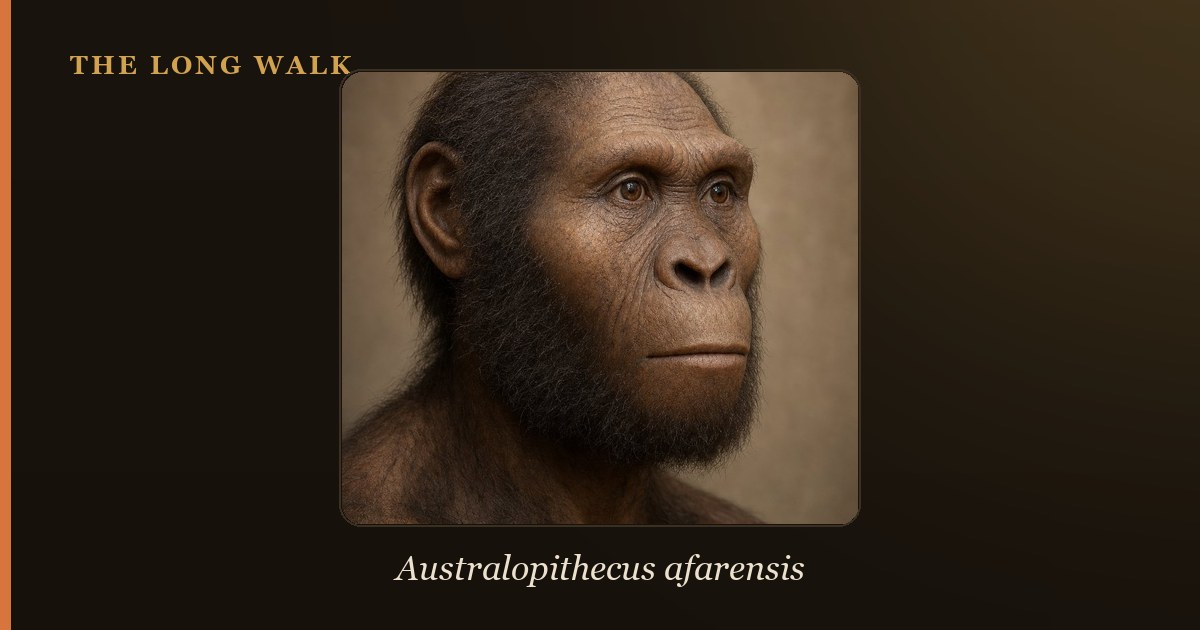
By the time of Australopithecus afarensis (around 3.2 million years ago), bipedalism was unmistakable. Lucy, the most famous afarensis skeleton, displays a fully committed bowl-shaped pelvis and inward-angled knees. The Laetoli footprints, preserved in volcanic ash in Tanzania and dated to 3.66 million years ago, provide the most direct evidence: two sets of hominin feet walked side by side across soft ash, their strides smooth and upright, leaving prints nearly identical to modern human feet. By this point, bipedalism was not a novelty but a way of life.
The Anatomy of Walking on Two Legs
Bipedalism leaves unmistakable marks on the skeleton. When paleoanthropologists find a fossil, they search for a cluster of traits that signal upright walking. A forward-placed foramen magnum tells us the skull balanced atop the spine, not slung forward. An S-shaped spine with a pronounced lumbar curve kept the trunk upright and the center of gravity over the legs. A short, bowl-shaped pelvis supported the organs and anchored the abdominal muscles that stabilize walking. An inward-angled femur, called valgus, brought the knees beneath the body rather than splayed to the side—a crucial change that reduced the mechanical stress of each stride.
The foot undergoes its own transformation. The ancestral ape foot has a grasping big toe that spreads outward, perfect for gripping branches. In bipedal hominins, the big toe aligns with the other four, creating an arched foot that acts like a spring, storing and releasing energy with each step. This redesign allows for efficient, distance-covering walking—something our ancestors needed as they ranged across open landscapes.
Hands tell an equally important story. In apes, the hands and arms carry weight during knuckle-walking. In bipedal hominins, they are liberated. No longer needed to move the body, hands could carry food back to camp, fashion objects into tools, cradle infants, and later, gesture and communicate. This freedom of the hand is central to the human story.
Why Did It Happen? The Leading Ideas
If bipedalism was so costly—inducing back pain, difficult childbirth, and slow running—why evolve it at all? Scientists have proposed several overlapping hypotheses, none fully proven but each supported by evidence.
Hand provisioning. Anthropologist Owen Lovejoy argued that upright posture freed the hands to carry food—meat, seeds, fruits—back to a home base, where a mate and offspring could be provisioned. This encouraged pair-bonding and investment in fewer, higher-quality offspring. In a patchy environment where food is scattered and rare, the ability to gather and transport it confers huge advantage.
Energy efficiency. Walking upright may use less energy than knuckle-walking over distance. Biomechanist Herman Pontzer and others have shown that bipedal walking, once perfected, is more economical than the locomotion of apes. Over millions of years of ranging farther for food, this efficiency compounds.
Thermoregulation. Anthropologist Peter Wheeler proposed that standing tall reduced the body's exposure to the intense midday heat of the African sun—less surface area catching direct rays—and allowed wind to cool the legs and lower trunk. For an animal ranging in open or semi-open habitats, staying cool during the hottest hours could extend foraging time and reduce water loss.
Feeding posture. Some researchers suggest bipedalism allowed ancestors to stand and reach food sources—seeds in trees, prey to stalk—from an upright posture. This idea has roots in the observation that some tree-dwelling apes adopt brief bipedal postures to feed. Our ancestors may have begun this way, and natural selection later refined it into a way of life.
The truth likely involves all four factors, acting together in changing environments. Bipedalism was not a single adaptation to a single problem, but a solution to multiple pressures that made standing on two legs increasingly worthwhile.
The Hidden Costs of Two Legs
Bipedalism is a bargain with a cost. The human body carries the weight of this ancient choice every day. The S-curve of our spine, while elegant, creates points of stress and vulnerability. Lower-back pain is so common in modern humans that it feels inevitable, yet it reflects the engineering compromises bipedalism demands. Our ancestors in the past suffered it too, as evidenced by arthritic changes in ancient spines.
Childbirth became a life-threatening ordeal. A narrow pelvis—necessary for efficient bipedal walking—conflicts with the large head of a big-brained baby. Hominin mothers faced the perpetual risk of obstructed labor. Evolution partially solved this through shorter pregnancy and more dependent infants, but the danger never fully vanished. Even today, pregnancy and childbirth carry real risks.
Humans are also slow runners compared to many African predators, and bipedalism—while good for walking—is less suited to sprinting than the quadrupedal gait of a cheetah or a lion. Our ancestors could not outrun danger; they had to out-think it, out-group it, and out-cooperate it. Perhaps this vulnerability drove the growth of brains and social complexity that came later.
Why It Matters for Human Evolution
Bipedalism is the foundation of the human story. It predates the large brain by at least two to three million years. It preceded stone tools by roughly the same span. This means that for millions of years, our ancestors walked on two legs, had modest brains, and lived lives we can barely imagine. They were not us yet, but they were on the path.
Understanding why bipedalism evolved reshapes how we see human origins. It shows that we did not spring fully formed from the savanna, driven by a hunger for meat and the need to see over tall grass. Instead, our ancestors made a slow, incremental shift in how they moved—one that carried costs but opened doors. Freed hands led to carrying, then to tool use, then to new ways of thinking. Upright posture may have altered how we see, hear, and interact with the world, shifting our social and sensory experience. That quiet revolution, unfolding over hundreds of thousands of years, set the stage for everything that followed: language, art, culture, and civilization.
The next time you stand and walk, remember: you are performing an ancient, hard-won feat. Your spine, your pelvis, your knee, your foot—all bear witness to a choice your distant ancestors made millions of years ago, when they rose from four legs to two and began the long walk that led to us.
See when upright walking first appears in the fossil record on the interactive deep-time tree.
Explore the family tree →Frequently asked questions
Why did humans start walking upright?
No single cause is agreed. Bipedalism appears 6 to 7 million years ago, long before large brains or stone tools. Leading ideas include saving energy while travelling, carrying food and reaching fruit from the ground.
What are the earliest known bipedal hominins?
The oldest candidates are Sahelanthropus tchadensis (the "Toumaï" skull from Chad, ~7 Ma), whose forward-placed foramen magnum hints at an upright head, and Orrorin tugenensis ("Millennium Man" from Kenya, ~6 Ma), whose thighbone shows bipedal loading. Both are debated. Clear, habitual bipedalism is unmistakable by Australopithecus afarensis (~3.2 Ma).
Did humans walk upright before evolving big brains?
Yes — by a wide margin. Our ancestors walked on two legs by 6–7 million years ago, while large brains and stone tools appear only around 2–3 million years ago. Upright walking, not intelligence, is the founding trait of the human lineage.
- Lovejoy, C.O. et al. (2009). 'The great divides: Ardipithecus ramidus and the origins of hominid bipedalism.' Science 326. science.org
- Smithsonian Human Origins — Walking upright. humanorigins.si.edu
- Britannica — Bipedalism. britannica.com