Australopithecus afarensis (East Africa, ~3.9–2.9 Ma, famous for Lucy) and A. africanus (South Africa, ~3.3–2.1 Ma, famous for the Taung Child and Mrs Ples) were both small-brained, upright-walking 'gracile' australopiths that still climbed trees. Africanus is slightly later and more derived in some features. Both are candidate ancestors of later Homo and the robust Paranthropus line.
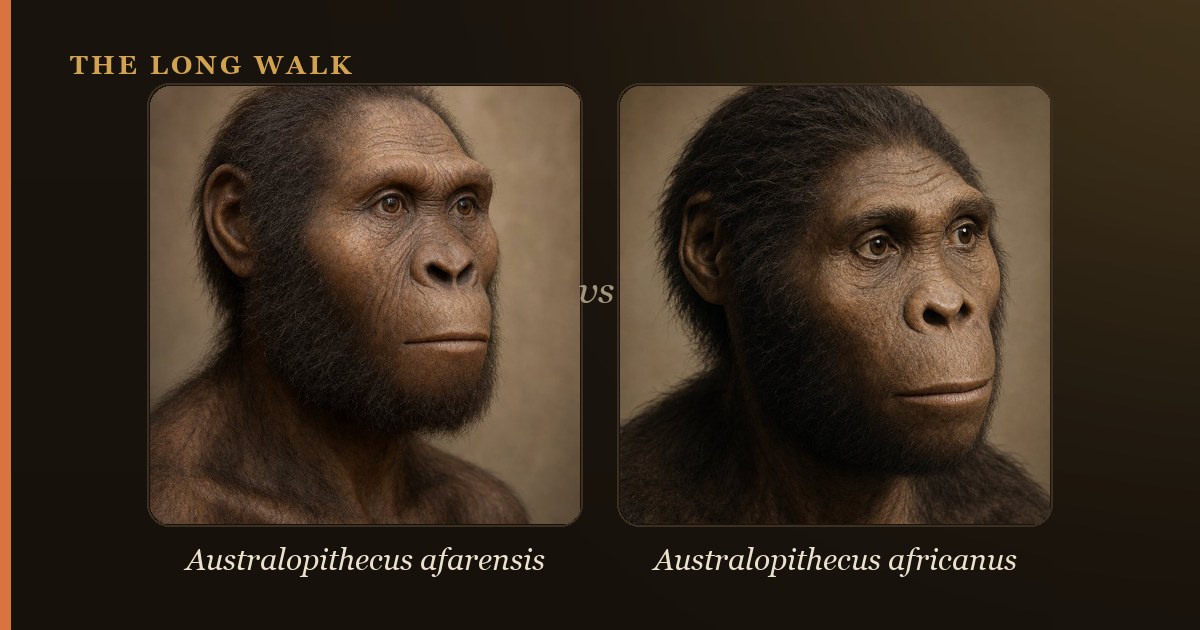
Two fossils dominate the public image of the australopiths. Lucy — a 3.2-million-year-old skeleton from Ethiopia — is Australopithecus afarensis. Mrs Ples — a beautifully preserved skull from a South African cave — is Australopithecus africanus, the very first early human ancestor ever identified, back in 1924.
The Australopithecus afarensis vs africanus comparison sets East Africa against South Africa, and one gracile australopith against another. They are close cousins — but the differences between them sit right at the root of our own genus.
| Australopithecus afarensis and africanus compared | A. afarensis | A. africanus |
|---|---|---|
| Lived | ~3.9–2.9 million years ago | ~3.3–2.1 million years ago |
| Region | East Africa (Ethiopia, Tanzania, Kenya) | South Africa (Cradle of Humankind) |
| Brain size | ~380–490 cc | ~400–560 cc |
| Height | ~1.0–1.5 m (strong size dimorphism) | ~1.1–1.4 m |
| Face / skull | More projecting, primitive | Rounder skull, somewhat more derived |
| Famous fossils | Lucy (AL 288-1); Laetoli footprints | Taung Child; Mrs Ples (Sts 5) |
| Key sites | Hadar, Laetoli, Dikika | Taung, Sterkfontein, Makapansgat |
| Relationship | Possible ancestor of africanus & Homo | Ancestor of Homo and/or Paranthropus |
Who was Australopithecus afarensis?
Australopithecus afarensis lived in East Africa between roughly 3.9 and 2.9 million years ago. It is known from a superb fossil record, above all Lucy (AL 288-1) from Hadar, Ethiopia, and the Laetoli footprints in Tanzania — 3.66-million-year-old tracks frozen in volcanic ash that prove a confident upright stride. Afarensis walked the ground on two legs but kept long arms, curved fingers, and a cone-shaped ribcage for climbing.
Its brain was small (~380–490 cc), its face projecting and ape-like, and its body strongly size-dimorphic — males much larger than females. Widely regarded as a plausible ancestor of later hominins, it anchors the gracile australopith radiation. See the Australopithecus afarensis page.
Before Lucy: Australopithecus anamensis and the MRD skull
Push back another half-million years and you reach Australopithecus anamensis (~4.2–3.8 Ma), the earliest known member of the genus — its name means "southern ape of the lake," after ancient Lake Turkana in Kenya, where the first jaws and a tell-tale bipedal tibia turned up (Kanapoi and Allia Bay). For decades anamensis had no face. That changed in 2019, when Yohannes Haile-Selassie's team announced the near-complete MRD cranium from Woranso-Mille, Ethiopia, dated to ~3.8 Ma: a small ~370 cc braincase, a projecting snout, and large ape-like canines on a body that already walked upright.
MRD also unsettled the tidy textbook story. The old view was anagenesis — anamensis simply transforming into afarensis in a single line. But MRD at 3.8 Ma overlaps with the 3.9-million-year-old Belohdelie frontal bone assigned to afarensis, implying the two coexisted for a spell. Many researchers now read them as sister species branching from a common ancestor rather than a straight ancestor-to-descendant sequence — another reminder that the base of our tree is a bush, not a ladder.
Who was Australopithecus africanus?
Australopithecus africanus is the South African gracile australopith, living from about 3.3 to 2.1 million years ago. It holds a special place in history: the Taung Child, described by Raymond Dart in 1925, was the first fossil to suggest that humanity's origins lay in Africa. Decades later, Mrs Ples (Sts 5) from Sterkfontein became its iconic adult skull.
Africanus shares the small brain and climbing-and-walking body of afarensis, but its skull is a touch more rounded and some of its features are slightly more derived. Its exact role — ancestor of Homo, of the robust Paranthropus, or both — is debated. Full account on the Australopithecus africanus page.
The key differences
Geography and time
The cleanest split is where and when. Afarensis is the earlier, East African form; africanus is later and South African. Their ranges and (mostly) their time spans do not overlap, making them successive rather than simultaneous players.
Skull and teeth
Afarensis has a more projecting, primitive face and larger front teeth; africanus shows a somewhat rounder braincase and, in some specimens, larger cheek teeth — a faint hint in the direction of the heavy-chewing Paranthropus that would follow in South Africa.
Body
Both retained climbing adaptations alongside committed bipedalism. Afarensis shows especially marked differences in body size between the sexes; the picture for africanus is less clear because its skeletal sample is sparser.
How we know they walked upright: Laetoli and Hadar
Two East African sites turned afarensis from a set of bones into a walking animal. At Laetoli in Tanzania, Mary Leakey's team uncovered a trail of footprints pressed into volcanic ash 3.66 million years ago — Footprint Trail G, made by two or three individuals striding side by side. The prints show a modern heel-strike, an arched foot and a push-off from the ball, with no ape-like splayed toe: direct behavioural proof of habitual bipedalism, recorded in the ground rather than inferred from a skeleton.
At Hadar in Ethiopia, the evidence is anatomical. Lucy (AL 288-1), found by Donald Johanson in 1974, is a ~40% complete, 3.2-million-year-old skeleton whose pelvis, knee and foot are built for upright walking even as her long arms hint at lingering tree-climbing. Nearby, the "First Family" (AL 333) — a cluster of individuals of all ages — let researchers gauge the range of the species. The footprints predate Lucy by nearly half a million years, showing this gait was stable long before brains began to grow. For the why behind it, see why humans started walking upright.
Did they ever meet?
Almost certainly not. Separated by thousands of kilometres and, for the most part, by time, the two species occupied different corners of Africa. The interest is genealogical: many researchers see afarensis as ancestral to africanus, or both as branches close to the origin of Homo; a younger South African species, Australopithecus sediba, has its own claim to that position. They are relatives passing the baton across the continent, not contemporaries sharing a watering hole.
Why it matters
These two species are the workhorses of australopith science — the fossils on which ideas about early bipedalism, diet, growth, and the origin of Homo are tested. Comparing them shows that the gracile australopiths were not a single uniform stage but a varied, continent-spanning group, and it frames the central question of this part of the tree: which of these small-brained walkers gave rise to us?
Lucy and Mrs Ples both sit near the base of the human family tree. Open the interactive timeline to see how the australopiths branch toward Homo and Paranthropus.
Explore the family tree →Frequently asked questions
Who was Australopithecus afarensis?
An East African australopith that lived about 3.9 to 2.9 million years ago. Its fossils include Lucy (AL 288-1) from Hadar in Ethiopia, and it is the likely maker of the 3.66-million-year-old Laetoli footprints in Tanzania.
Who was Australopithecus africanus?
A South African australopith that lived roughly 3.3 to 2.1 million years ago. Raymond Dart's 1925 description of its first fossil, the Taung Child, was the first fossil evidence that humans arose in Africa.
Did they ever meet?
Almost certainly not. They lived thousands of kilometres apart and mostly at different times. The link between them is ancestry: many researchers think A. afarensis gave rise to A. africanus, or that both sit near the root of Homo.
What is Australopithecus anamensis and the MRD skull?
Anamensis (~4.2–3.8 Ma) is the earliest known australopith. Long known only from jaws and a bipedal shin bone, it got a face in 2019 with the MRD cranium from Woranso-Mille, Ethiopia. Because MRD overlaps in age with early afarensis, many now see them as sister species rather than a simple ancestor and descendant.
How do we know afarensis walked upright?
Laetoli in Tanzania preserves 3.66-million-year-old footprints with a modern striding gait, and Hadar in Ethiopia produced Lucy (AL 288-1) and the First Family (AL 333) — skeletons built for upright walking. Behaviour and anatomy agree.
- Kimbel, W. H. & Delezene, L. K. (2009). "Lucy redux: A review of research on Australopithecus afarensis." Yearbook of Physical Anthropology 52. wiley.com
- Berger, L. R. & Hawks, J. — Australopithecus africanus overview; Sterkfontein. humanorigins.si.edu
- Leakey, M. D. & Hay, R. L. (1979). "Pliocene footprints in the Laetolil Beds, Tanzania." Nature 278. nature.com