Australopithecus was a genus of small-brained, upright apes that lived ~4–2 million years ago. Homo naledi shares many of those primitive traits — including a brain of just 465–610 cc — but it lived only about 335,000–236,000 years ago and is placed in our own genus, Homo. The shock is the timing: an australopith-grade body surviving into the age of Homo sapiens.
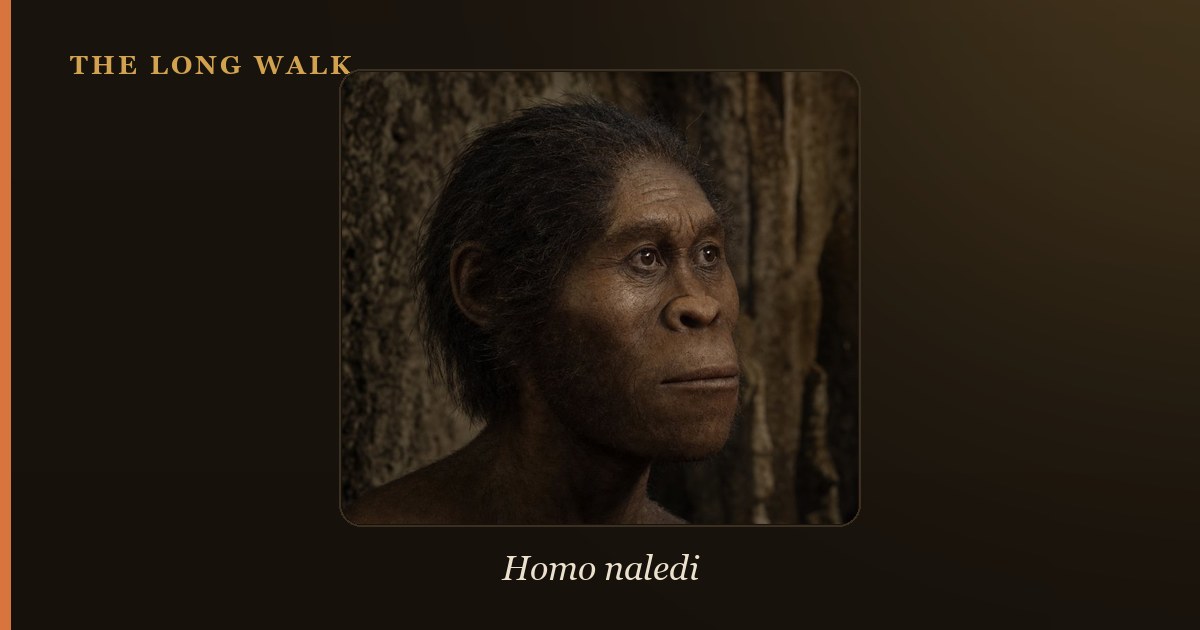
When Homo naledi was unveiled in 2015, the assumption was that anything this primitive — a brain barely a third the size of ours, curved climbing fingers, flaring ape-like hips — must be ancient, two or three million years old. Then, in 2017, the dates came back: just 335,000 to 236,000 years ago. This creature was a contemporary of the first Homo sapiens.
That makes Homo naledi vs Australopithecus one of the most revealing comparisons in palaeoanthropology. On a checklist of bones, naledi looks like an australopith. On a calendar, it is millions of years out of place. Untangling the two shows just how messy the human family tree really is.
| Homo naledi and Australopithecus compared | Homo naledi | Australopithecus (e.g. afarensis) |
|---|---|---|
| Lived | ~335,000–236,000 years ago | ~3.9–2.0 million years ago |
| Genus | Homo | Australopithecus |
| Brain size | 465–610 cc | ~380–550 cc |
| Height / mass | ~144 cm, ~40 kg | ~105–150 cm, ~30–45 kg |
| Key site | Rising Star Cave, South Africa | Hadar (Ethiopia), Sterkfontein (S. Africa) |
| Signature trait | Human-like feet & teeth, curved fingers | Bipedal pelvis, ape-like upper body |
| Famous fossil | Dinaledi assemblage (1,550+ pieces) | Lucy (AL 288-1); Taung Child |
| Tool use | No stone tools found with it; hand capable of toolmaking | None definitive; possibly the 3.3-Myr Lomekwi tools & Dikika cut marks (debated) |
| Fate | Extinct; relationship to us unclear | Ancestral stock of later Homo |
Who was Australopithecus?
Australopithecus ("southern ape") is the genus that bridged the gap between forest apes and the genus Homo. Its best-known member, Australopithecus afarensis, lived in East Africa between about 3.9 and 2.9 million years ago and is represented by Lucy (AL 288-1), the 3.2-million-year-old partial skeleton from Hadar, Ethiopia. The Taung Child, found in 1924, made A. africanus the first australopith ever recognised.
Australopiths walked upright on the ground — the Laetoli footprints freeze that gait in 3.66-million-year-old ash — but kept long arms, curved fingers, and a funnel-shaped chest for climbing. Their brains, 380–550 cc, were only modestly bigger than a chimpanzee's. They are widely regarded as the ancestral stock from which Homo emerged. See the full Australopithecus afarensis page.
Who was Homo naledi?
Homo naledi was announced in 2015 after an extraordinary haul from the Rising Star Cave system in South Africa's Cradle of Humankind. The Dinaledi Chamber, reachable only through a chute as narrow as 18 cm, yielded over 1,550 fossil specimens from at least 15 individuals — one of the richest hominin assemblages ever found. A team of slender "underground astronauts" was recruited to reach it.
Naledi is a true mosaic. Its feet, lower limbs, wrists, and teeth are remarkably human-like, while its small brain (465–610 cc), curved fingers, flaring pelvis, and shoulder built for climbing are pure australopith. It stood about 1.44 m tall and weighed around 40 kg. Its discoverers have controversially argued it deliberately placed bodies in the cave — and even made engravings on the walls — though both claims are hotly debated. Read more on the Homo naledi species page.
The key differences
Time — the headline
This is everything. Australopithecus had vanished by roughly two million years ago. Homo naledi lived around 300,000 years ago, overlapping with early Homo sapiens, Neanderthals, and Denisovans. A body plan that looks two million years old persisted into the late Middle Pleistocene.
What's in a name
Its discoverers placed naledi in Homo, not Australopithecus, citing its human-like hands, feet, and teeth. But its small brain blurs the line — it shows that the traits we use to define "human" did not all evolve as one neat package. You can be Homo in your feet and australopith in your skull.
Anatomy, point by point
Both have small brains and climbing-adapted upper bodies. But naledi's feet are almost indistinguishable from ours and its teeth are small and simple, whereas australopiths have more primitive feet and, in robust forms, huge molars. The overall impression is of two different solutions, hundreds of millennia and a genus name apart, that happen to share a deep-time toolkit.
The small brain that may have buried its dead
The sharpest argument in palaeoanthropology right now sits exactly at the seam of Homo naledi vs Australopithecus: can a brain of 465–610 cc — australopith-sized, a third of ours — produce behaviour we had assumed required a large one? The Dinaledi Chamber forced the question. The deposit holds the remains of at least 15 individuals, from infants to the elderly, with almost no other large-animal bones, no signs of predator damage, and no evidence of a flood or single mass-death event sweeping them in. In 2015 the discovery team argued the simplest remaining explanation was deliberate body disposal — naledi carrying its dead deep into a dark, hard-to-reach cave.
In 2023 the team went further, posting preprints describing what they read as dug graves with bodies in them, cross-hatched engravings scratched into the cave walls, and the controlled use of fire. If correct, a small-brained hominin was performing mortuary behaviour and mark-making tens of thousands of years before such acts are firmly documented for large-brained Homo sapiens or Neanderthals.
Many specialists are not convinced. Critics — including researchers reviewing the papers in eLife's open model — argue the burial claim has not ruled out natural accumulation: bodies that fell or were dropped into the chamber, sediment that slumped around them over time, or remains washed into low spots. The engravings remain undated, so there is no proof naledi made them rather than later visitors. The debate is genuine and unresolved. What is not in dispute is the stakes: if even part of the disposal hypothesis holds, brain size is a far worse predictor of complex behaviour than the textbook story of human evolution ever allowed.
Did they ever meet?
No. They are separated by nearly two million years. The interest is not contact but survival: naledi shows that small-brained, australopith-like hominins lingered far longer than anyone expected, alongside — but not descended from — the big-brained humans of the late Ice Age. Whether naledi is a relic of an early Homo branch or something else entirely is still open.
Two small-brained survivors: Homo naledi and Homo floresiensis
Naledi is not the only small-brained human that hung on surprisingly late. On the Indonesian island of Flores, Homo floresiensis — the "hobbit," known from the LB1 skeleton found in Liang Bua cave in 2003 — stood barely a metre tall with a brain of only ~420 cc and survived until roughly 50,000 years ago. Like naledi, it pairs a tiny brain with a mix of primitive and more human-like traits, and it overlapped in time with modern humans without descending from them.
But the two reached small brains by different roads. Floresiensis is widely explained by island dwarfism — a population of Homo erectus (or something earlier) shrinking in isolation on a resource-poor island, just as Flores's elephants dwarfed. Naledi had no such island: it was a small-bodied hominin on the African mainland, most likely a long-surviving branch of early Homo that simply never grew a big brain. Together they make the same point twice — brain size and "modernity" did not march in step, and the late Ice Age hid archaic-looking humans in both Africa and Asia.
Why it matters
For decades, human evolution was told as a ladder: brains swell, tools improve, an ape becomes us. Homo naledi breaks the ladder. It proves that "primitive" and "recent" are not contradictions, that brain size and body shape can march to different clocks, and that Africa hosted a far more crowded cast of hominins — overlapping in time — than the textbooks once allowed.
Place Homo naledi and the australopiths side by side on the interactive timeline and see just how far apart in time these look-alikes really lived.
Explore the family tree →Frequently asked questions
Who was Australopithecus?
A genus of small-brained, upright-walking hominins that lived from roughly 4.2 to 2 million years ago. Its best-known species, A. afarensis, includes Lucy (AL 288-1), a 3.2-million-year-old partial skeleton from Hadar, Ethiopia.
Who was Homo naledi?
A small-brained Homo species from the Rising Star Cave system in South Africa, announced in 2015. The Dinaledi Chamber alone produced more than 1,550 fossil pieces from at least 15 individuals.
Did they ever meet?
No. Homo naledi lived around 335,000 to 236,000 years ago, long after Australopithecus died out. Its importance is that a small-brained hominin survived so late, alongside larger-brained humans.
How is Homo naledi different from the Flores hobbit?
Both are small-brained humans that survived late without being our ancestors. But Homo floresiensis (Flores, ~50,000 years ago, ~420 cc) is explained by island dwarfism, while Homo naledi (~335,000–236,000 years ago, 465–610 cc) lived on the African mainland with no isolation — most likely a long-surviving early-Homo branch.
Where were the Homo naledi fossils found, and what is Sterkfontein?
Homo naledi comes from the Rising Star cave system in South Africa's Cradle of Humankind (the Dinaledi and Lesedi chambers). Nearby Sterkfontein yielded Australopithecus fossils such as Mrs Ples and "Little Foot" — the same limestone country preserving hominins millions of years apart.
- Berger, L. R. et al. (2015). "Homo naledi, a new species of the genus Homo from the Dinaledi Chamber, South Africa." eLife 4. elifesciences.org
- Dirks, P. H. G. M. et al. (2017). "The age of Homo naledi and associated sediments in the Rising Star Cave." eLife 6. elifesciences.org
- Berger, L. R. et al. (2023). "Evidence for deliberate burial of the dead by Homo naledi." eLife (reviewed preprint). elifesciences.org
- Smithsonian Human Origins Program — Homo naledi and Australopithecus afarensis species profiles. humanorigins.si.edu