Australopithecus are the 'gracile' australopiths (~4.2–2 million years ago) — lighter-jawed, generalised, and the likely ancestral stock of both later Homo and Paranthropus. Paranthropus are the 'robust' australopiths (~2.7–1.2 million years ago) — heavy jaws, huge molars, and bony crests for powerful chewing. They overlapped in time, but only one branch led to us.
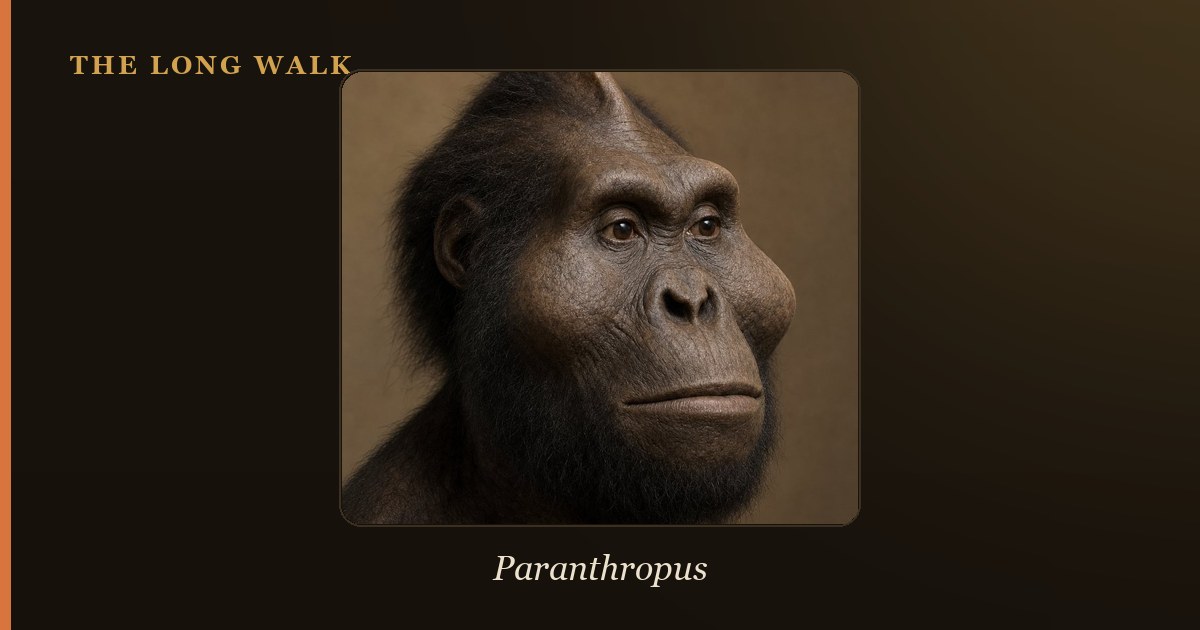
Walk through the australopiths and you meet two body types wearing very different faces. The gracile ones — the genus Australopithecus — have lighter jaws and a generalised look. The robust ones — the genus Paranthropus — have massive cheekbones, enormous molars, and a crest of bone along the skull to anchor jaw muscles like a vice.
The Paranthropus vs Australopithecus comparison is really about a fork in the road. One branch of these small-brained walkers led, eventually, to us; another doubled down on chewing and became an evolutionary dead end. Telling them apart shows how that split unfolded.
| Paranthropus and Australopithecus compared | Paranthropus (robust) | Australopithecus (gracile) |
|---|---|---|
| Lived | ~2.7–1.2 million years ago | ~4.2–2.0 million years ago |
| Skull | Massive jaw, sagittal crest, flaring cheeks | Lighter jaw, no/low crest |
| Cheek teeth | Enormous (megadont) | Moderate |
| Brain size | ~500–550 cc | ~380–560 cc |
| Diet | Tough/low-quality plant foods (chewing specialist) | Broad, generalised omnivore |
| Members | aethiopicus, boisei, robustus | anamensis, afarensis, africanus, others |
| Famous fossils | OH 5 (Zinj), Black Skull, DNH 7 | Lucy, Taung Child, Mrs Ples |
| Fate | Extinct ~1.2 Ma (side branch) | Ancestral stock of Homo & Paranthropus |
Who were the Australopithecus (gracile) australopiths?
Australopithecus — the gracile australopiths — lived from about 4.2 to 2 million years ago and include A. anamensis, A. afarensis (Lucy), and A. africanus (the Taung Child, Mrs Ples). They were small-brained, upright-walking hominins with lighter jaws and a more generalised, omnivorous build. Crucially, they are the ancestral stock: one lineage of gracile australopiths is thought to have led to Homo, and another to the robust Paranthropus. Read the afarensis and africanus pages for detail.
Who were the Paranthropus (robust) australopiths?
Paranthropus — the robust australopiths — appeared around 2.7 million years ago and includes three species: P. aethiopicus (the 2.5-million-year-old "Black Skull"), P. boisei in East Africa, and P. robustus in South Africa. They share a dramatic chewing apparatus: huge flat molars, thickly enamelled, set in heavy jaws, with flaring cheekbones and a sagittal crest anchoring powerful muscles. Behind that fortress sat a small brain (~500–550 cc). Isotopes show they leaned on tough, low-quality plant foods. See the Paranthropus boisei page.
The key differences
The chewing machine
The defining contrast is the masticatory system. Paranthropus took heavy chewing to an extreme — megadont molars, buttressed jaws, crests for muscle attachment, a dished face. Australopithecus kept a more moderate, generalised jaw. Everything about the robust skull is engineered around grinding force.
Diet and ecology
The robust anatomy points to a diet of hard or fibrous fallback foods — the tough stuff that gets an animal through lean seasons. Gracile australopiths ate a broader, more flexible diet. This dietary divergence likely drove the anatomical split.
Same below the neck
Strikingly, both were similar in body size, brain size, and upright posture. The robust–gracile difference is concentrated almost entirely in the skull and teeth — a vivid example of how a single ecological pressure (what you chew) can reshape one part of the body while leaving the rest much the same.
How are they related?
The robusts did not come from nowhere: Paranthropus almost certainly evolved from a gracile Australopithecus ancestor, with the Black Skull (P. aethiopicus) marking an early, primitive stage of the robust line. Whether all three robust species form a single natural group, or whether their heavy jaws evolved more than once, is still debated. Either way, the genus Australopithecus sits at the fork; Paranthropus is one prong of it, our own genus the other.
The three robust species: aethiopicus, boisei & robustus
The robust experiment produced three species, and they line up as a sequence in time and specialisation. Paranthropus aethiopicus is the oldest and most primitive (~2.7–2.3 Ma), known above all from the Black Skull (KNM-WT 17000), found by Alan Walker west of Lake Turkana in 1985 and stained blue-black by manganese in the sediment. It already carries a towering sagittal crest and a projecting face, but a tiny ~410 cc braincase — a clear bridge from gracile ancestors to the full robust form.
Paranthropus boisei, East Africa's "Nutcracker Man" (~2.3–1.2 Ma), pushed the design to its limit: the widest chewing apparatus and largest molars of any hominin, thick enamel, and a brain of ~500–550 cc. Its type specimen, OH 5 (originally Zinjanthropus), was found by Mary Leakey at Olduvai Gorge in 1959; the near-complete KNM-ER 406 from Lake Turkana is another classic. Tellingly, carbon isotopes show boisei ate mostly C4 grasses and sedges — not the hard nuts its jaws suggest. Most researchers read aethiopicus and boisei as a single East African lineage evolving through time (anagenesis).
Paranthropus robustus is the South African cousin (~2.0–1.2 Ma) and the first robust ever described — Robert Broom named it from Kromdraai in 1938. Rich samples come from Swartkrans and the more recently excavated Drimolen, where the fine cranium DNH 7 ("Eurydice") was recovered. It carries the same heavy jaw and crest in slightly less extreme form, on a more mixed C3/C4 diet. Geography is the cleanest divide of all: boisei belongs to the East African Rift, robustus to the dolomitic caves of South Africa's Cradle of Humankind, thousands of kilometres apart — and the two never met.
Did they ever meet?
Yes. The later gracile australopiths overlapped with early Paranthropus, and the robusts then shared the landscape with the first members of Homo — habilis and erectus — for hundreds of thousands of years. For a long stretch of the early Pleistocene, several kinds of upright, small-brained and large-brained hominins lived side by side across Africa.
Why it matters
This is the comparison that contains a fork in our own ancestry. From the gracile australopith stock, evolution ran two experiments: one invested in chewing and produced the robust Paranthropus, which thrived for over a million years before dying out; the other invested in brains, tools, and flexibility and produced us. Looking at Paranthropus is looking at the path our ancestors did not take.
See where the gracile and robust australopiths branch — and where our own genus splits off — on the interactive deep-time tree.
Explore the family tree →Frequently asked questions
Who were the Australopithecus (gracile) australopiths?
Lightly built australopiths that lived about 4.2 to 2 million years ago, including A. anamensis, A. afarensis and A. africanus. They walked upright, had small brains and ate a broad diet.
Who were the Paranthropus (robust) australopiths?
Heavy-jawed australopiths that appeared about 2.7 million years ago. There are three species: P. aethiopicus, known from the Black Skull, P. boisei in East Africa and P. robustus in South Africa.
How are they related?
Paranthropus almost certainly evolved from an Australopithecus ancestor. The Black Skull, P. aethiopicus, shows an early stage of the robust line.
What is the difference between Paranthropus boisei and robustus?
Mainly geography and degree. P. boisei lived in the East African Rift and is the most extreme robust, with the largest molars of any hominin; P. robustus lived in South African caves and is a more moderate robust with a more mixed diet. They were thousands of kilometres apart and never met.
Did Paranthropus aethiopicus evolve into boisei?
Most researchers think so. Aethiopicus (the ~2.5-million-year-old Black Skull) has the robust hallmarks in less extreme form and overlaps in time and place with the earliest boisei, so the two are usually read as one East African lineage evolving through time.
- Wood, B. & Constantino, P. (2007). "Paranthropus boisei: Fifty years of evidence and analysis." Yearbook of Physical Anthropology 50. wiley.com
- Wood, B. & Strait, D. (2004). "Patterns of resource use in early Homo and Paranthropus." J. Human Evolution 46. sciencedirect.com
- Smithsonian Human Origins — Paranthropus & Australopithecus. humanorigins.si.edu