Homo habilis ('handy man', ~2.3–1.5 Ma) was small-bodied with a brain of ~510–690 cc and made simple Oldowan tools. Homo erectus (~1.9 Ma–110 ka) had a tall modern body, a larger brain, Acheulean technology, and spread across the Old World. Once seen as a neat ancestor–descendant pair, the two actually overlapped in time in East Africa — complicating the straight-line story.
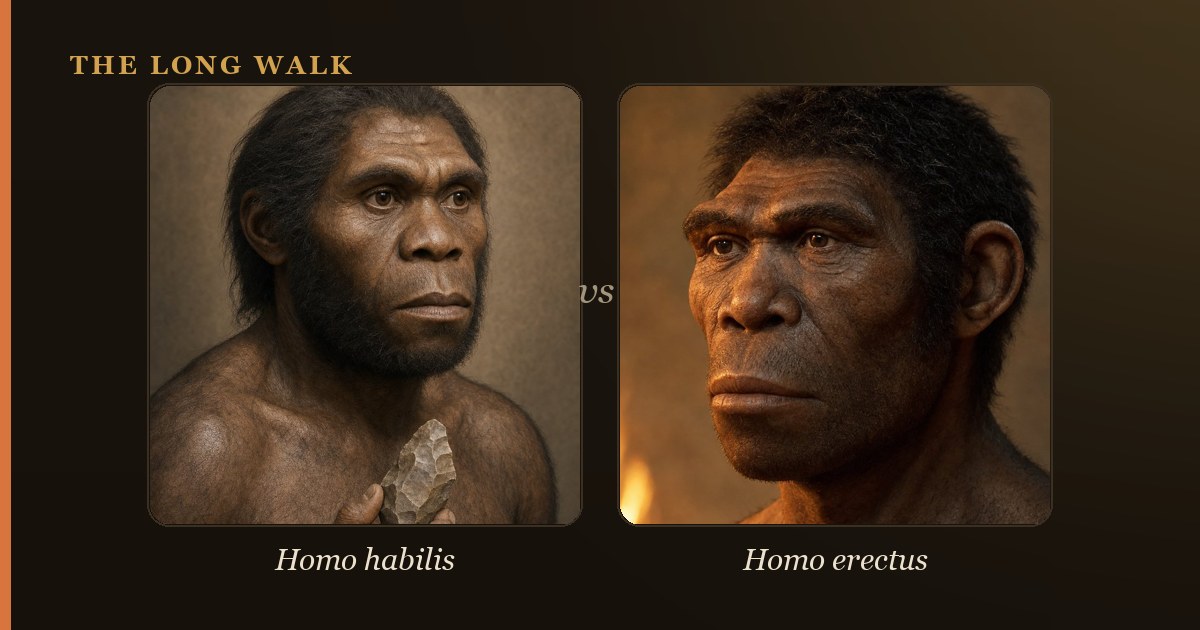
In 1964, Louis Leakey gave a small-brained, tool-associated fossil from Olduvai Gorge a bold name: Homo habilis, the "handy man" — the first creature he was willing to call human. A few hundred thousand years later (or so the story went), it gave rise to Homo erectus, the tall traveller who would leave Africa. Tidy. Linear. Ancestor to heir.
Then fossils from Lake Turkana showed the two living at the same time. The Homo habilis vs Homo erectus comparison turns out to be less a relay race than a crowded starting line for our genus. Here is how they differ — and why the overlap matters.
| Homo habilis and Homo erectus compared | Homo habilis | Homo erectus |
|---|---|---|
| Lived | ~2.3–1.5 million years ago | ~1.9 million–110,000 years ago |
| Range | East & South Africa only | Africa, Caucasus, South & East Asia |
| Brain size | ~510–690 cc | ~600–1,100 cc |
| Height | ~1.0–1.3 m | ~1.45–1.85 m |
| Body plan | Small, long-armed, primitive | Tall, long-legged, modern proportions |
| Tools | Oldowan (Mode 1) flakes & cores | Oldowan then Acheulean handaxes |
| Key fossils | OH 7, KNM-ER 1813, OH 24 | Turkana Boy, Dmanisi, Java & Peking Man |
| Fate | Extinct ~1.5 Ma | Persisted in Java to ~110,000 years ago |
Who was Homo habilis?
Homo habilis lived in East and South Africa between about 2.3 and 1.5 million years ago. It was small — perhaps 1.0–1.3 m tall — with long, still somewhat ape-like arms, a primitive body, and a brain of roughly 510–690 cc: bigger than an australopith's, but well short of ours. Its name reflects its association with the first widespread stone tools, the Oldowan.
The type specimen, OH 7, came from Olduvai Gorge in 1960–64; KNM-ER 1813 from Lake Turkana and OH 24 ("Twiggy") fill out the picture. Habilis is a genuinely transitional creature, and some researchers argue it (and its relative H. rudolfensis) sits so close to the australopiths that it barely belongs in Homo at all. See the Homo habilis page.
Who was Homo erectus?
Homo erectus appeared by about 1.9 million years ago and changed the game. It had essentially modern body proportions — long legs, short arms, a tall striding frame built for walking and running across open country. The 1.6-million-year-old Turkana Boy would have stood around 1.8 m as an adult. With this body, erectus became the first hominin to leave Africa, reaching Dmanisi in Georgia by 1.8 Ma and eventually Java and China.
Its brain, 600–1,100 cc, grew over time, and its toolkit advanced from Oldowan flakes to the symmetrical Acheulean handaxe. It is the longest-surviving human species of all. Full details on the Homo erectus page.
The key differences
The body
This is the clearest break. Habilis kept a small, primitive, partly arboreal body; erectus had the long-legged, ground-committed frame that defines later humans. The shift in body plan — not just brain size — is what many anthropologists treat as the real beginning of Homo.
Range and tools
Habilis stayed in Africa and made Mode 1 Oldowan tools. Erectus carried technology out of Africa and, in much of its range, developed the planned, bifacial Acheulean. The leap in stone tools mirrors the leap in geography. (For the toolkits themselves, see Oldowan vs Acheulean.)
Brain
The ranges overlap at the low end, but erectus reaches far higher — its later populations approached the modern range, while habilis never did.
Did they ever meet?
Yes — and this is the twist. Fossils from the Turkana Basin show Homo habilis and Homo erectus both present between roughly 1.9 and 1.5 million years ago. A 2007 study of specimens from Ileret confirmed the two coexisted for around half a million years. That overlap means erectus cannot have evolved from this population of habilis in a simple straight line — both more likely sprang from an earlier common ancestor and then ran in parallel for a long stretch.
Early Homo was crowded: rudolfensis and Australopithecus sediba
Habilis and erectus were not the only players. A third early-Homo form, Homo rudolfensis, is built around KNM-ER 1470, a skull found at Koobi Fora (east of Lake Turkana) in 1972. Next to habilis it has a larger, flatter, broader face, bigger cheek teeth, and a somewhat bigger braincase (~700–750 cc). Fresh face and jaw fossils published in 2012 reinforced the case that a second distinct early-Homo form really did live alongside habilis. Whether they are two species, one variable species, or barely Homo at all is still unresolved — the debate hinges largely on skulls, since rudolfensis body bones are hard to identify.
Stranger still is Australopithecus sediba, found in 2008 at Malapa, South Africa, by a team led by Lee Berger (the first bones spotted by his nine-year-old son). Dated to 1.98 Ma, the skeletons MH1 ("Karabo") and MH2 are a mosaic: a tiny ~420 cc australopith brain and long climbing arms, but a surprisingly modern pelvis, a precision-grip hand, and small Homo-like teeth. Berger argued sediba was ancestral to Homo — but there is a timing problem: Homo is already present by ~2.8 Ma (the Ledi-Geraru jaw) and habilis by 2.3 Ma, so sediba arrives too late to be their ancestor. Most now read it as a late-surviving side branch that nonetheless shows the kind of anatomy from which our genus emerged.
Why it matters
The habilis–erectus story used to be the cleanest chapter in the human book: the moment an ape-like toolmaker straightened up and strode toward us. The overlap rewrote it. Early Homo was not a single advancing line but a small radiation of species sharing the African landscape — some staying small and local, one acquiring the body and brain to conquer three continents. Our genus began not with a step, but with a branching bush.
See how Homo habilis and Homo erectus overlap in time, and where each sits in the rise of our genus, on the interactive deep-time tree.
Explore the family tree →Frequently asked questions
Who was Homo habilis?
An early Homo species from East and southern Africa, about 2.3 to 1.5 million years ago. It stood about 1.0 to 1.3 m tall, kept long arms, and had a brain of roughly 510 to 690 cc.
Who was Homo erectus?
A taller, longer-legged species that appeared by about 1.9 million years ago and had roughly modern body proportions. Its most complete skeleton is the 1.6-million-year-old Turkana Boy from Kenya.
Did they ever meet?
Yes. Fossils from Ileret, east of Lake Turkana, described in 2007, show both species living in the same basin for roughly half a million years, between about 1.9 and 1.5 million years ago.
What is Homo rudolfensis and the skull KNM-ER 1470?
Homo rudolfensis is an early-Homo form built around KNM-ER 1470, a skull from Koobi Fora near Lake Turkana. It has a larger, flatter face and a somewhat bigger braincase (~700–750 cc) than habilis. Whether the two are one variable species or two is unresolved.
Is Australopithecus sediba a human ancestor?
Probably not directly. Sediba (Malapa, ~1.98 Ma) has a mosaic of australopith and Homo-like traits, but Homo already existed by ~2.8 Ma, so it arrived too late to be that ancestor. Most see it as a late-surviving side branch.
- Spoor, F. et al. (2007). "Implications of new early Homo fossils from Ileret, east of Lake Turkana, Kenya." Nature 448. nature.com
- Antón, S. C. (2003). "Natural history of Homo erectus." Yearbook of Phys. Anthropology 46. wiley.com
- Smithsonian Human Origins — Homo habilis. humanorigins.si.edu