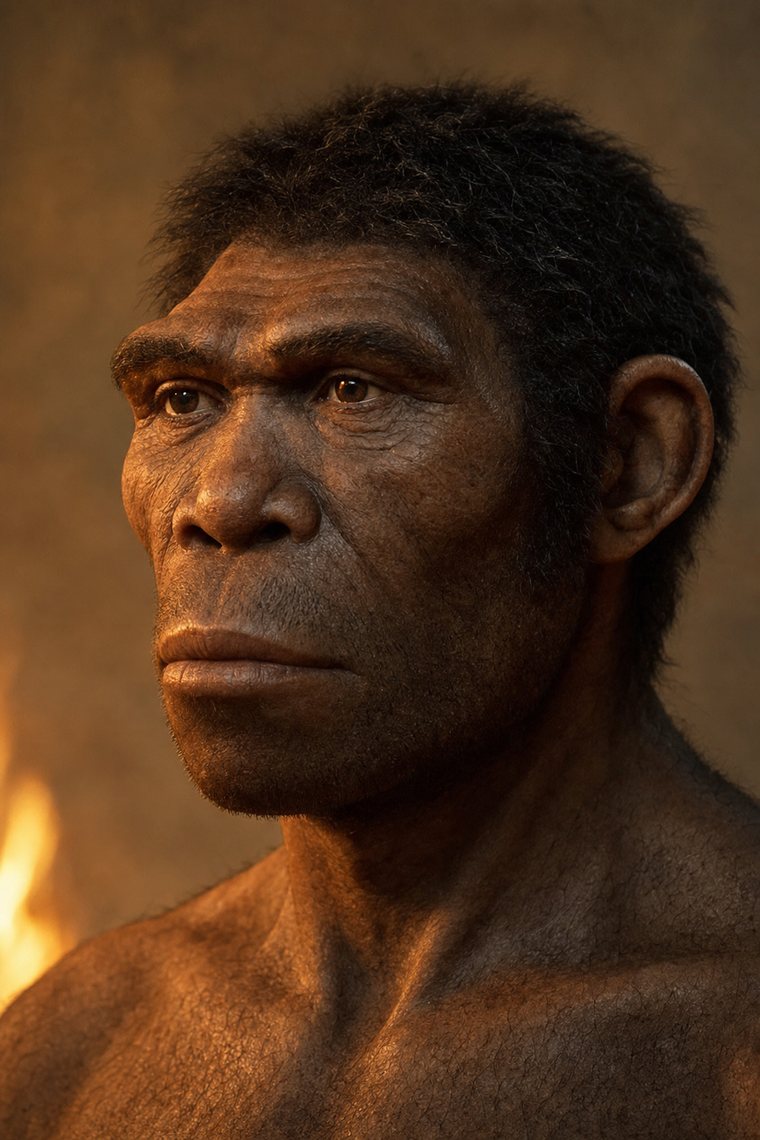
Homo erectus
The great pioneer: the first human to walk out of Africa, master fire, and endure for over a million years.
Overview
Homo erectus is arguably the most important species in our story. It was the first hominin with essentially modern body proportions, the first to spread out of Africa across Asia, and one of the longest-lived of all human species — persisting for well over a million years.
From 'Java Man' and 'Peking Man' to Kenya's superbly preserved 'Turkana Boy', erectus fossils span three continents.
Anatomy & Body
H. erectus had a tall, striding, fully terrestrial body built for endurance walking and running in open landscapes — long legs, short arms, narrow hips. The skull kept archaic features: a long low braincase, a strong continuous brow ridge, and no chin.
Over its vast time span, brain size grew from about 600 cc in early African forms to over 1,000 cc in later populations.
Brain & Cognition
The expanding brain went hand-in-hand with new behaviours. H. erectus planned ahead, exploited large territories, and cared for individuals who could not fend for themselves — an old, toothless skull from Dmanisi (Georgia) suggests its group helped it survive.
Behavior & Culture
H. erectus is linked to the Acheulean handaxe — a symmetrical, carefully shaped tool that persisted for over a million years. Strong evidence indicates erectus controlled and used fire, which cooked food, extended the day, and opened cold new lands.
Cooking may have helped fuel the very brain expansion that defines later humans.
Key Fossils
- KNM-WT 15000 (“Turkana / Nariokotome Boy”) — a near-complete juvenile skeleton from Kenya.
- “Java Man” (Trinil) and “Peking Man” (Zhoukoudian) — the classic Asian discoveries.
- The Dmanisi skulls (Georgia) — the earliest hominins known outside Africa (~1.8 Ma).
Relationship to Us
Homo erectus is the trunk from which later large-brained humans grew — almost certainly ancestral, directly or indirectly, to H. heidelbergensis, the Neanderthals, the Denisovans, and us.
Discovery & history
Homo erectus is the only hominin ever found by someone who set out deliberately to find a missing link and succeeded. Eugène Dubois, a Dutch army surgeon, took a posting in the Dutch East Indies in 1887 specifically to search for human ancestors in the tropics. At Trinil on Java in 1891–92 he recovered a skullcap and a thigh bone and named them Pithecanthropus erectus — "Java Man".
The reception was hostile. Dubois spent decades defending the find, and by some accounts withdrew the fossils from examination entirely for a period.
Confirmation came from China. Excavations at Zhoukoudian near Beijing from the 1920s, led first by Davidson Black and later by Franz Weidenreich, produced a large collection of "Peking Man" material. In one of the worst losses in the history of the discipline, the original fossils vanished in 1941 while being evacuated ahead of the Japanese advance. Only Weidenreich's casts and descriptions survive.
Two later finds transformed the picture: KNM-WT 15000, the near-complete "Turkana Boy" skeleton found by Kamoya Kimeu in 1984, and the 1.8-million-year-old assemblage at Dmanisi in Georgia, excavated from 1991.
Debates & open questions
One species or two? Some researchers split the African material off as Homo ergaster, reserving H. erectus for the Asian fossils, on the basis of cranial differences. Others treat the whole set as one geographically variable species. The site that has done most to undercut splitting is Dmanisi: five skulls from a single place and time show a range of variation nearly as wide as that used elsewhere to justify separate species names. Lordkipanidze and colleagues argued in 2013 that palaeoanthropology has been over-splitting a single evolving lineage.
How long did it last? Very long, and possibly longer than anyone expected. A 2020 redating of the Ngandong site on Java placed the youngest erectus fossils at roughly 117,000–108,000 years ago — meaning the species survived while Homo sapiens was already spreading out of Africa.
Did it control fire? This is the big behavioural question and it is not settled. Burnt bone and ashed sediment from Wonderwerk Cave in South Africa, around a million years old, is the most-cited evidence. Sceptics point out that distinguishing managed fire from natural burning in deposits this old is extremely difficult, and that unambiguous hearths appear much later.