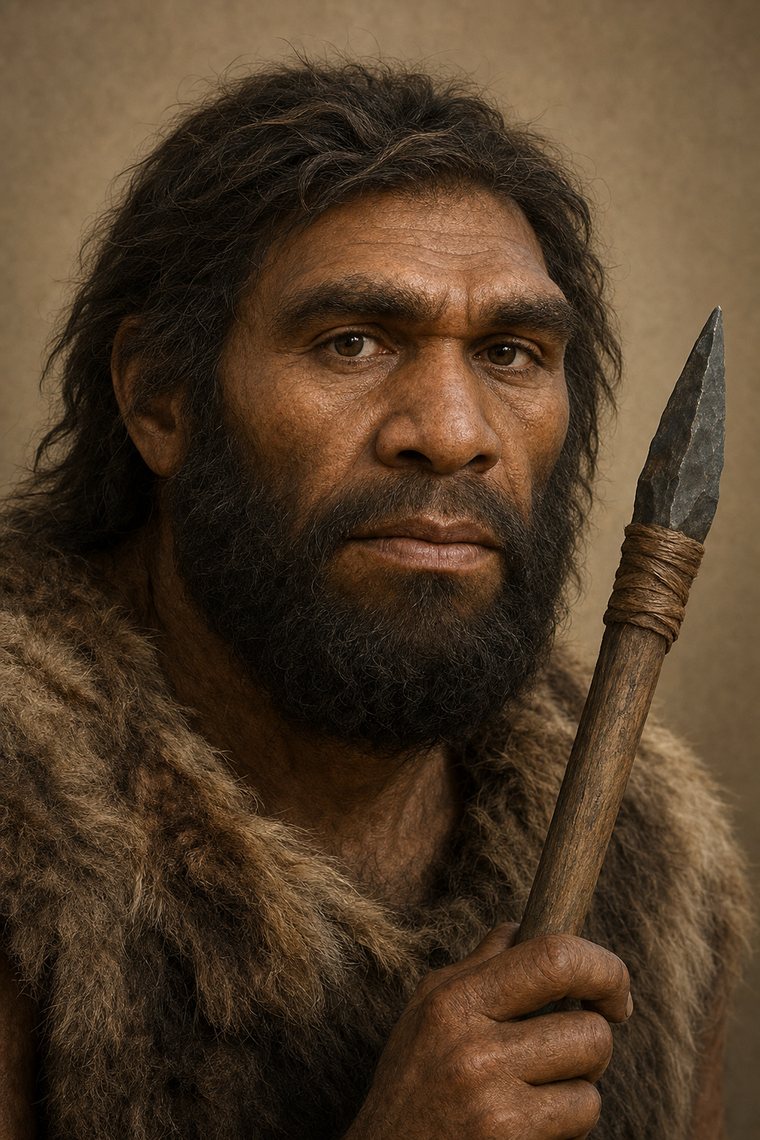
Homo heidelbergensis
The crossroads species — big-brained hunters whose descendants would split into Neanderthals, Denisovans and us.
Overview
Homo heidelbergensis sits at the great fork in the human tree. Many researchers see it as the common ancestral population that, in Africa, gave rise to Homo sapiens, and in Eurasia gave rise to the Neanderthals and Denisovans.
Its brain was nearly modern in size, and the archaeological traces it left — wooden spears, butchered big game, possibly deliberate disposal of the dead — reveal sophisticated planning and cooperation. (Note: the name is used differently by different scientists, and the African and European fossils may eventually be split.)
Anatomy & Body
H. heidelbergensis was tall, robust and powerfully built, with a large braincase, a heavy double-arched brow ridge, a broad face and no chin. The body was adapted to a range of climates, from African savanna to glacial Europe.
Brain & Cognition
Brain volumes of 1,100–1,400 cc overlap the modern human range. Combined with the archaeology, this points to advanced foresight: designing tools for future tasks, coordinating hunts of dangerous prey, and managing fire and shelter.
Behavior & Culture
The Schöningen spears (Germany, ~300,000 years old) are beautifully balanced wooden throwing spears — proof of planning depth and skilled woodworking. At Boxgrove (England), heidelbergensis butchered horse and rhino with Acheulean handaxes.
At Spain's Sima de los Huesos, dozens of individuals accumulated at the bottom of a deep shaft — possibly the earliest evidence of deliberate treatment of the dead.
Key Fossils
- The Mauer jaw (Germany) — the type specimen, found in 1907.
- Sima de los Huesos (Atapuerca, Spain) — a vast assemblage of Neanderthal-precursor remains.
- Kabwe / “Broken Hill” skull (Zambia) — a key African specimen (sometimes called H. rhodesiensis).
Relationship to Us
If any single species deserves the title 'our immediate ancestor', it is heidelbergensis — the population whose children became the three great human lineages of the late Ice Age.
Discovery & history
The species is founded on a single jaw. In 1907 a worker in a sandpit at Mauer, near Heidelberg, uncovered a robust hominin mandible from about 24 metres down. Otto Schoetensack described it the following year as Homo heidelbergensis, noting that the jaw was massive and chinless but the teeth were essentially human in proportion.
For most of the twentieth century the name was little used. It was revived from the 1980s as a label for the growing set of Middle Pleistocene fossils that were clearly neither Homo erectus nor fully Neanderthal or modern.
The species' reputation rests less on its bones than on what it left behind. Between 1994 and 1998, Hartmut Thieme recovered a set of wooden throwing spears from a lignite mine at Schöningen in Germany, preserved by waterlogged sediment for roughly 300,000 years. They are carefully shaped from spruce, weighted forward like a modern javelin, and were found among the butchered remains of dozens of horses. They are the oldest complete hunting weapons known, and they demolished the then-common view of Middle Pleistocene humans as marginal scavengers.
Debates & open questions
This species is at the centre of what palaeoanthropologists openly call "the muddle in the middle" — the taxonomic confusion surrounding Middle Pleistocene Homo.
The problem is that H. heidelbergensis has been used as a catch-all for almost any fossil from roughly 700,000 to 300,000 years ago that resists easier classification, across Africa, Europe and Asia. Specimens grouped under the name differ substantially from one another, and the type specimen is a jaw, which limits comparison with fossils known mainly from braincases.
Ancient DNA has since redrawn part of the map. The huge assemblage from Sima de los Huesos in Spain was long assigned to heidelbergensis. When Matthias Meyer's team recovered nuclear DNA from it in 2016, the sequences came out on the Neanderthal branch. Most researchers now treat the Sima population as early Neanderthals rather than heidelbergensis, which removes the best-sampled population from the species.
Proposals to fix this have not settled it. Some would restrict heidelbergensis to the Mauer jaw and European material, using H. rhodesiensis for African fossils. A 2021 proposal by Mirjana Roksandic and colleagues introduced Homo bodoensis for the African and southeast European specimens; it drew immediate objections and has not been widely adopted.
What survives all of this is the functional claim: some Middle Pleistocene population was hunting large game with engineered weapons, and it was ancestral to us.