Homo erectus (~1.9 million–110,000 years ago) was the first hominin with a modern body plan and the first to leave Africa, but with a smaller brain (~600–1,100 cc) and a robust, brow-ridged skull. Homo sapiens (~300,000 years ago to today) added a larger, globular brain, a lighter skeleton, a chin, and far more complex technology and symbolism. Most researchers see erectus as part of our ancestral lineage.
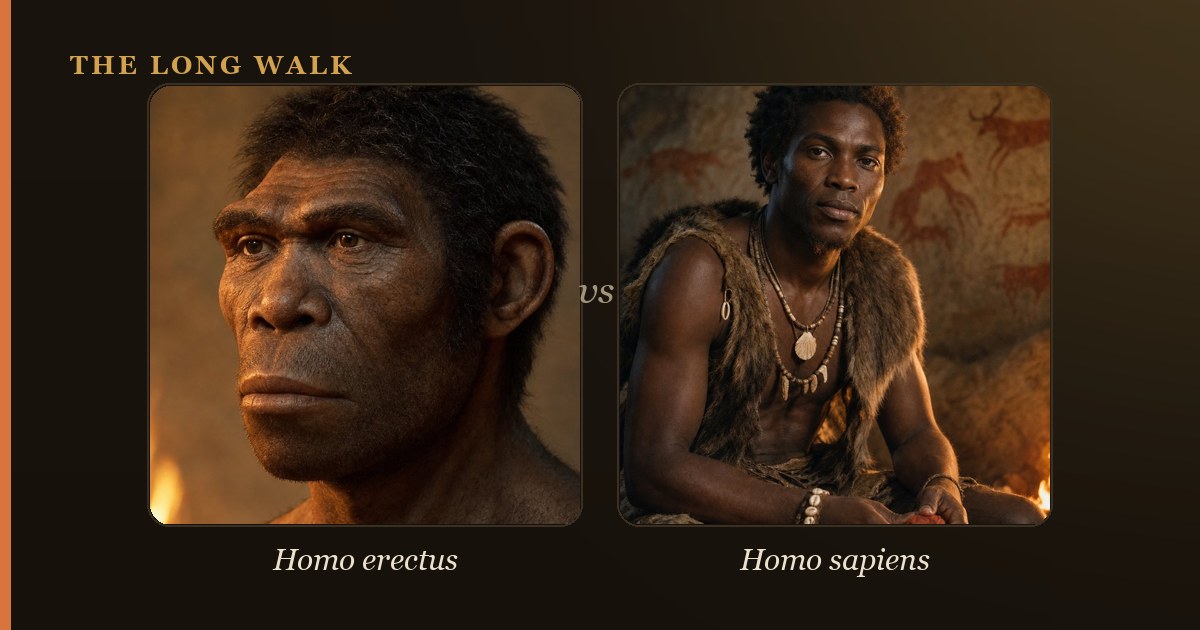
If you saw a Homo erectus from the neck down, you might not look twice — it had long legs, short arms, and the tall, striding body of a committed ground-dweller, almost two million years before us. From the neck up, though, the differences are stark: a smaller brain, a long flat skull, a heavy brow, and no chin.
The Homo erectus vs Homo sapiens comparison is essentially the story of what happened after the modern body evolved — how brain, skull, and culture were remodelled on the way to us. And it raises a direct question: was erectus our ancestor?
| Homo erectus and Homo sapiens compared | Homo erectus | Homo sapiens |
|---|---|---|
| Lived | ~1.9 million–110,000 years ago | ~300,000 years ago to present |
| Range | Africa, Caucasus, South & East Asia | Africa, then worldwide |
| Brain size | ~600–1,100 cc | ~1,350 cc (globular) |
| Skull | Long & low, thick, big brow | High, rounded, small brow, chin |
| Body | Modern proportions, robust | Modern proportions, gracile |
| Tools | Oldowan, then Acheulean handaxes | MSA, then Upper Palaeolithic |
| Fire & symbolism | Likely fire; little symbolism | Fire, art, language, complex culture |
| Fate | Extinct (Java) ~110,000 years ago | Sole surviving human |
Who was Homo erectus?
Homo erectus appeared in Africa by about 1.9 million years ago and was a genuine turning point. It was the first hominin with essentially modern body proportions — long legs, short arms, a tall frame built for walking and running across open landscapes. With that body came the first great expansion beyond Africa, reaching Dmanisi in Georgia by 1.8 million years ago and eventually Java and China.
Its brain grew over time from around 600 cc to over 1,000 cc, and its toolkit advanced from simple Oldowan flakes to the symmetrical Acheulean handaxe. It mastered fire and survived for well over a million and a half years — the longest run of any human species. See the full Homo erectus page.
Who are Homo sapiens?
Homo sapiens arose in Africa by ~300,000 years ago. We kept the modern body but refined it — lighter bones, a smaller face, a high globular braincase averaging ~1,350 cc, and a chin. Our real signature, though, is behavioural: cumulative culture, symbolic art, complex language, and technology that changes within generations rather than over hundreds of millennia. More on the Homo sapiens page.
The key differences
The head, not the body
Below the neck, erectus and sapiens are strikingly similar — the modern frame was already in place. The big changes are cranial: brain size grew by roughly a third, the skull rounded out, the brow shrank, the face flattened and tucked under, and a chin appeared. Evolution did its most dramatic remodelling above the shoulders.
Technology and pace of change
The Acheulean handaxe stayed almost unchanged for over a million years under erectus. Modern human technology, by contrast, accelerates — new tool types, materials, and styles appear constantly. That shift from near-static to cumulative culture may be the deepest difference of all.
Symbolism
Erectus left little clear evidence of art or symbolism (a possible engraved shell from Java is a rare, debated hint). With sapiens, the symbolic record becomes overwhelming. Whether that reflects a hard cognitive boundary or a gradual build-up is still argued.
Did they ever meet?
Quite possibly. Late Homo erectus survived in Java until around 110,000 years ago — the Ngandong fossils — overlapping with the time modern humans were beginning to disperse through Asia. There is no direct fossil evidence of contact between the two, but the windows of time and geography brush against each other. Unlike with Neanderthals and Denisovans, no erectus DNA has been recovered, so any interbreeding remains hypothetical.
Was Homo erectus our ancestor?
Most likely, yes — at least in part. The mainstream view is that African Homo erectus (sometimes split off as Homo ergaster) gave rise to later forms like Homo heidelbergensis, which in turn led to Homo sapiens in Africa and the Neanderthals and Denisovans in Eurasia. The Asian erectus populations, meanwhile, were long-lived side branches that eventually died out. So erectus sits on or very near the main line to us, even if the Javanese hold-outs were distant cousins.
Why it matters
Comparing erectus and sapiens isolates what is genuinely special about modern humans — and what is not. The upright, long-legged, far-walking body that feels so human was already finished nearly two million years ago. What makes us us came later and from the neck up: a bigger, reorganised brain and a mind that builds culture upon culture. We are, in a sense, an old body carrying a new kind of mind.
Follow the line from Homo erectus through heidelbergensis to modern humans on the interactive deep-time tree, and see where each species sits.
Explore the family tree →Frequently asked questions
Who was Homo erectus?
A human species that appeared in Africa by about 1.9 million years ago and spread into Asia. It was the first hominin with long legs, short arms and roughly modern body proportions.
Who are Homo sapiens?
Our own species, which appeared in Africa by about 300,000 years ago. Compared with Homo erectus we have lighter skeletons, smaller faces, a chin and a rounded braincase averaging about 1,350 cc, along with art and fast-changing technology.
Did they ever meet?
Possibly. The last Homo erectus, at Ngandong in Java, dates to about 110,000 years ago, when modern humans may have been moving into Asia. No fossil or archaeological site yet shows the two together.
- Antón, S. C. (2003). "Natural history of Homo erectus." Yearbook of Physical Anthropology 46. wiley.com
- Rizal, Y. et al. (2020). "Last appearance of Homo erectus at Ngandong, Java, 117,000–108,000 years ago." Nature 577. nature.com
- Hublin, J.-J. et al. (2017). "New fossils from Jebel Irhoud... origin of Homo sapiens." Nature 546. nature.com
- Smithsonian Human Origins — Homo erectus. humanorigins.si.edu