Homo antecessor is an extinct human species known from roughly 800,000-year-old fossils at Gran Dolina in Spain — the earliest well-documented hominin of Western Europe. It is famous for a surprisingly modern-looking face combined with primitive teeth, and for cut-marked bones that record the earliest known cannibalism in Europe. Its exact place on the human family tree remains hotly debated.
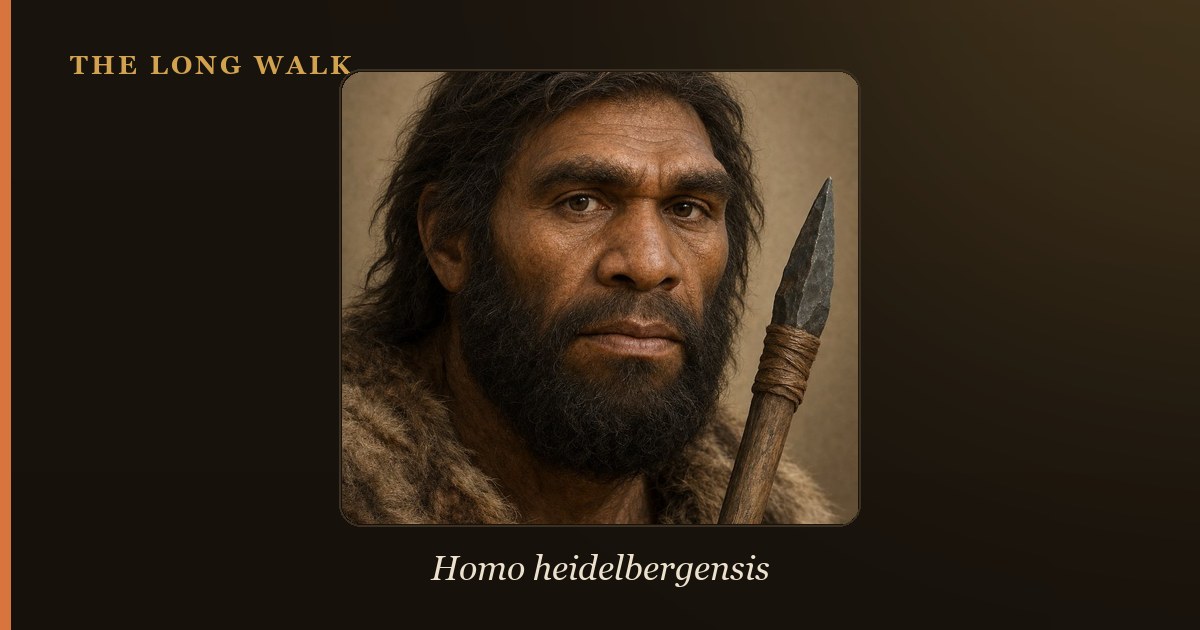
In 1994, excavators digging through a thin band of cave sediment in northern Spain pulled out human bones unlike anything Europe had produced before. The fossils came from Gran Dolina, level TD6, in the Sierra de Atapuerca — and many of them were the broken, cut-marked remains of children. Homo antecessor, the species named from these finds, turned out to be both the oldest firmly dated human of Western Europe and the bearer of an unsettling distinction: the earliest evidence of cannibalism in the European record.
What made the discovery electrifying was not only the violence but the face. One specimen — a juvenile nicknamed the "Boy of Gran Dolina" (ATD6-69) — preserves a midface that looks eerily modern, with the hollowed, flattened cheeks we associate with our own species, set against teeth and a browline that are distinctly archaic. That mosaic of old and new features turned Homo antecessor into one of the most argued-over hominins of the last thirty years.
| Homo antecessor at a glance | Homo antecessor |
|---|---|
| Lived | ~1.2 million–0.8 million years ago (TD6 ~0.8–0.9 Ma) |
| Where | Gran Dolina (TD6), Sierra de Atapuerca, northern Spain |
| Brain size | ~1,000–1,100 cc (estimated) |
| Body | Tall, modern-like proportions; adults est. ~160–180 cm |
| Key fossils | "Boy of Gran Dolina" (ATD6-69); >170 fragments from TD6 |
| Tools | Mode 1 core-and-flake (Oldowan-like); no handaxes at TD6 |
| Discovered | 1994; named 1997 (Bermúdez de Castro, Arsuaga & Carbonell) |
| Status | Extinct; phylogenetic position contested |
Discovery at Gran Dolina
The Sierra de Atapuerca, near Burgos, is one of the richest fossil-hominin landscapes on Earth, riddled with caves that filled with sediment over more than a million years. In 1994 and 1995, a team led by Eudald Carbonell, José María Bermúdez de Castro, and Juan Luis Arsuaga reached a layer in the Gran Dolina cave called level TD6, also known as the "Aurora stratum" after the first tooth found there.
TD6 yielded more than 170 human bone fragments belonging to at least six individuals, most of them children and adolescents, alongside stone tools and animal remains. In 1997 the team published the find in Science and assigned it to a new species: Homo antecessor, from the Latin for "pioneer" or "explorer" — a fitting name for what was then the oldest known human in Western Europe. Subsequent dating placed TD6 at roughly 0.8 to 0.9 million years old, and additional craniodental material from the site pushes the species' range back toward 1.2 million years. You can place it in deep time on the interactive family tree.
The modern-face puzzle
The single most discussed feature of Homo antecessor is its face. In most archaic humans of this period, the midface projects forward and the cheeks are inflated. The Gran Dolina juvenile is different: it shows a true canine fossa — a hollow beneath the cheekbone — and a flatter, more vertical midface of the kind once thought unique to Homo sapiens. To eyes trained on later fossils, the boy looks almost like us.
But the rest of the skeleton tells an older story. The teeth retain primitive traits, the brow is heavy, and the braincase is modest — an estimated 1,000 to 1,100 cubic centimetres, well below the modern average. Anthropologists call this combination a mosaic: modern-looking features bolted onto an archaic frame. The face is the puzzle precisely because it appears so early. Was that modern midface an ancestral condition retained by later humans, or did it evolve more than once? The honest answer is that researchers still disagree.
Evidence of cannibalism
Many of the human bones from TD6 carry the same marks butchers leave on animal carcasses: cut marks from stone flakes where muscle was sliced from bone, peeling and percussion damage from extracting marrow, and the same discard pattern as the deer and horse bones found beside them. The remains were processed for meat and then thrown away with the food refuse.
This makes Gran Dolina the site of the earliest documented cannibalism in Europe, and among the oldest anywhere. Most of the victims were juveniles and young adults. Researchers debate the motive — survival in lean seasons, ritual, or "nutritional cannibalism" directed at outsiders to defend territory — but the physical evidence that human flesh was eaten is not in serious doubt. It is a stark reminder that these were full members of the human story, capable of behaviour that is both deeply familiar and disturbing.
Where does Homo antecessor fit?
This is where Homo antecessor earns its reputation as a troublemaker. When the species was named in 1997, its discoverers proposed something bold: that this was the last common ancestor of Neanderthals and modern humans, the population from which both later lineages descended. The modern-looking face seemed to support a special link to Homo sapiens.
That hypothesis is now contested. In 2020, a landmark study extracted ancient proteins from the enamel of a Gran Dolina tooth — pushing molecular evidence far beyond the limits of recoverable DNA. The protein sequences placed Homo antecessor not as a direct ancestor but as a closely related sister lineage that branched off near the base of the group containing modern humans, Neanderthals, and Denisovans. In other words, antecessor is more like a cousin to that whole clade than its grandparent.
So the modern face is probably not proof of direct ancestry. It may instead reflect features that were present early and then lost in some later lineages, or convergent evolution. The species sits close to a crucial fork in the human tree without, on current evidence, being the trunk itself. You can see how it relates to neighbouring species on the species overview.
Did it meet other humans?
At 0.8 to 0.9 million years ago, Homo antecessor shared a world with other early humans, though direct encounters are hard to prove. To the east, populations of Homo erectus ranged across Asia, and earlier hominins had already reached the edges of Europe, as the ~1.4-million-year-old tools and fragments from sites like Sima del Elefante (also at Atapuerca) attest. Antecessor itself was likely descended from an early dispersal out of Africa or the Near East.
What it almost certainly did not do is meet Neanderthals or Homo sapiens — both evolved much later. Within Atapuerca, the much younger Homo heidelbergensis-like population at the Sima de los Huesos pit (~430,000 years ago) shows clear Neanderthal traits and postdates antecessor by hundreds of thousands of years. The earliest Europeans, in short, were a thin and probably intermittent presence: small groups holding on at the cold northwestern frontier of the inhabited world.
Homo antecessor vs Homo heidelbergensis
The two are often confused because both are Pleistocene Europeans found at Atapuerca, but they are separated by time and grade. Antecessor (TD6, ~0.8–0.9 Ma) is older, with that famously modern midface on an otherwise archaic skull and a brain of ~1,000–1,100 cc. Homo heidelbergensis is later (~700–300 ka), bigger-brained (up to ~1,400 cc), and — at nearby Sima de los Huesos (~430 ka) — already shading into early Neanderthals. Rather than antecessor evolving straight into heidelbergensis, the 2020 protein evidence suggests antecessor sits just outside the modern-human/Neanderthal/Denisovan group, while heidelbergensis sits closer to (or within) it. Think cousin, not grandparent.
Why it matters
Homo antecessor matters because it anchors the start of the human story in Western Europe and complicates the neat lineage we once drew from older to younger species. Its modern face warns us that "modern" features can appear surprisingly early and need not signal direct ancestry. Its cut-marked bones show that complex, even shocking, behaviour reaches deep into the Pleistocene. And the 2020 protein work demonstrates that we can now read molecular signals from fossils nearly a million years old — a tool that may yet redraw the branches around this enigmatic pioneer. For now, antecessor remains exactly what its name promises: an early explorer, glimpsed at the threshold of Europe, whose full story is still being uncovered.
See exactly where Homo antecessor branches near the base of our lineage on the interactive deep-time tree — then trace how later humans spread across the continents.
Explore the family tree →Frequently asked questions
Where does Homo antecessor fit?
Its place is disputed. Its discoverers proposed in 1997 that it was the last common ancestor of Neanderthals and modern humans. Protein evidence from its tooth enamel, published in 2020, puts it instead on a side branch close to that common ancestor.
Did it meet other humans?
There is no direct evidence that it did. Around 800,000 to 900,000 years ago Homo erectus lived in Asia, and hominins had been in southern Europe since at least about 1.4 million years ago, but no site shows them meeting.
Is Homo antecessor the ancestor of Homo heidelbergensis and of us?
Probably not directly. Its discoverers proposed it as the last common ancestor of Neanderthals and modern humans, but 2020 protein evidence places antecessor as a sister lineage branching just outside the modern-human/Neanderthal/Denisovan group. Homo heidelbergensis is later and closer to that clade.
- Bermúdez de Castro, J.M. et al. (1997). "A hominid from the Lower Pleistocene of Atapuerca, Spain: possible ancestor to Neandertals and modern humans." Science 276. science.org
- Welker, F. et al. (2020). "The dental proteome of Homo antecessor." Nature 580. nature.com
- Carbonell, E. et al. (2010). "Cultural cannibalism as a paleoeconomic system in the European Lower Pleistocene." Current Anthropology 51. journals.uchicago.edu
- Australian Museum — Homo antecessor. australian.museum