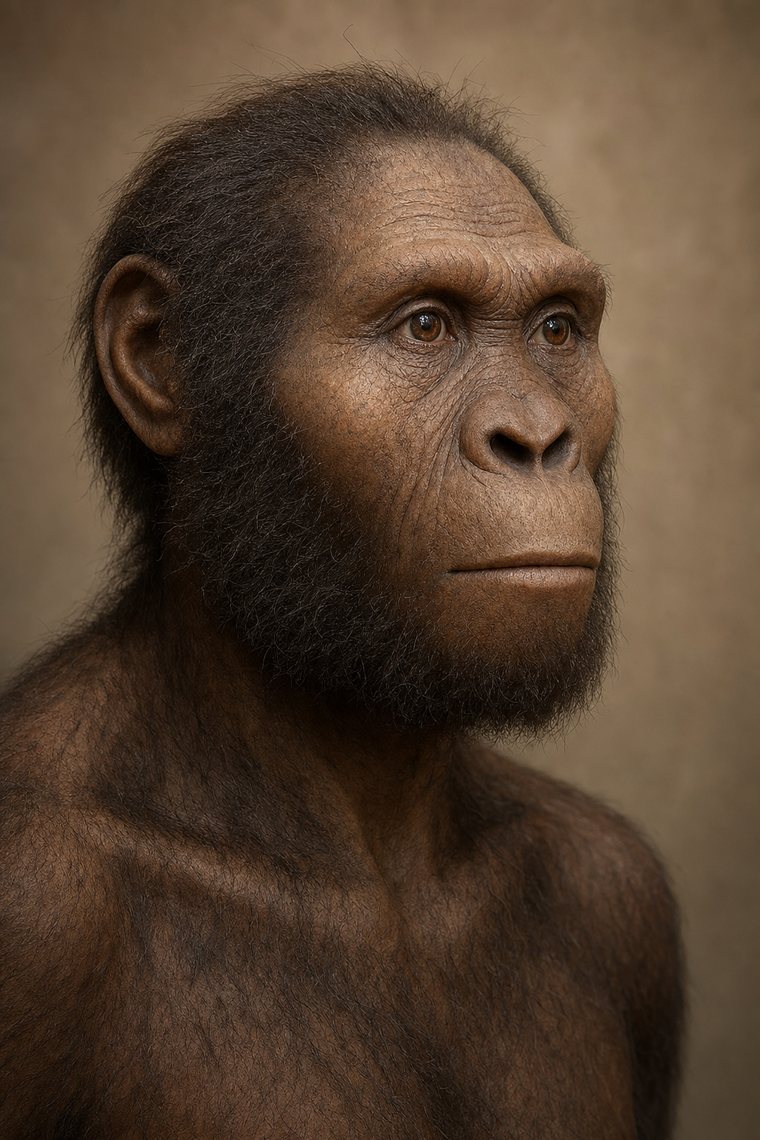
Australopithecus afarensis
Confidently bipedal on the ground — and the maker of footprints frozen in ash.
Overview
Australopithecus afarensis is the best-known early hominin, thanks to the 1974 discovery of Lucy — about 40% of a single skeleton — and the haunting Laetoli footprints, a trail of upright tracks pressed into volcanic ash 3.6 million years ago.
For nearly a million years this species thrived across eastern Africa, making it one of the most successful hominins ever and a leading candidate for the ancestor of our own genus.
Anatomy & Body
From the neck down, A. afarensis was committed to walking upright: a bowl-shaped pelvis, angled thigh bones and arched feet are all hallmarks of bipedalism. Yet curved fingers and toes and long arms reveal that it still climbed trees, probably for food and safe sleep.
It was strongly sexually dimorphic — males up to ~150 cm and females closer to ~105 cm — with an ape-like, forward-projecting face and a brain only modestly larger than a chimpanzee's.
Brain & Cognition
Brain volume of 380–430 cc is just above the chimpanzee range. Some endocast features hint at a slightly reorganised, slower-developing brain, but cognition was still broadly ape-grade.
Behavior & Culture
A. afarensis ate a flexible diet of fruits, leaves, seeds and possibly some meat. Cut-marked animal bones from Dikika hint — controversially — that members of this species may have used stone to access meat, though clear stone tools appear only later.
Key Fossils
- A.L. 288-1 (“Lucy”) — the iconic partial skeleton from Hadar, Ethiopia.
- The Laetoli footprint trail (Tanzania) — direct evidence of upright walking.
- DIK-1-1 (“Selam”/“Lucy's child”) — a remarkable juvenile skeleton.
Relationship to Us
Most researchers place A. afarensis at or near the base of the lineage that led to Homo, making Lucy something close to a great-great-grandmother of humanity.
Discovery & history
On the morning of 24 November 1974, Donald Johanson and graduate student Tom Gray were surveying a gully at Hadar in Ethiopia's Afar region when Johanson spotted a forearm bone. By the end of the season the team had recovered several hundred fragments of a single individual — about 40% of one skeleton, an unheard-of proportion for something over three million years old.
The Beatles' "Lucy in the Sky with Diamonds" was reportedly playing at the camp that night, and the name stuck. Johanson, Tim White and Yves Coppens formally named the species Australopithecus afarensis in 1978.
Three other finds define what we know. Site AL 333, the so-called "First Family", produced remains of at least thirteen individuals who appear to have died together. The Laetoli footprint trail in Tanzania, excavated by Mary Leakey's team between 1976 and 1978, preserved a line of upright tracks pressed into volcanic ash 3.6 million years ago. And in 2000 Zeresenay Alemseged recovered DIK-1-1 at Dikika — a three-year-old child, nicknamed Selam, whose skeleton is more complete than Lucy's.
Debates & open questions
The species has been argued over almost since it was named, and the disputes are still live.
One species or several? The afarensis hypodigm spans a very wide size range, from individuals around 105 cm to others near 150 cm. Johanson's team reads this as pronounced sexual dimorphism, with males far larger than females. Critics have periodically argued that a range that wide conceals more than one species. The 2010 discovery of "Kadanuumuu", a large male partial skeleton from Woranso-Mille, strengthened the dimorphism reading without ending the argument.
How much did it climb? From the neck down afarensis is committed to upright walking — a bowl-shaped pelvis, angled femora, arched feet. But it retains curved fingers and toes, long arms and an upward-facing shoulder socket. One camp treats these as functionally meaningless leftovers from an arboreal ancestor; the other treats them as evidence that the species still spent real time in trees, probably feeding and sleeping there. The Dikika child's shoulder blade, which is gorilla-like, is often cited by the second camp.
How did Lucy die? In 2016 John Kappelman and colleagues argued from her fracture pattern that she fell from a height, probably a tree. Tim White and others dismissed the fractures as ordinary post-burial damage seen throughout the Hadar assemblage.