Cannibalism in human evolution is well documented. The oldest clear case is at Gran Dolina, Spain, where Homo antecessor butchered at least 11 children and adolescents about 850,000 years ago. A 1.45-million-year-old leg bone from Kenya may be older still. Neanderthals at Moula-Guercy, El Sidrón and Goyet, and modern humans at Gough's Cave, also processed human bodies. The motives varied: hunger, conflict and ritual all fit different sites.
In 2023, Briana Pobiner and colleagues at the Smithsonian re-examined a hominin shin bone, KNM-ER 741, found at Koobi Fora in northern Kenya and dated to about 1.45 million years ago. Using 3D scans of the surface, they compared 11 marks on the bone with nearly 900 marks of known origin. Nine matched cuts made by stone tools. Two looked like tooth marks from a big cat.
Someone had cut flesh from that leg. The bone could belong to Homo erectus or Paranthropus boisei, so it may record one species butchering another rather than true cannibalism. Even so, it frames the uncomfortable topic of cannibalism in human evolution: eating human flesh is not a rare aberration, but a behaviour that appears again and again in the record.
How archaeologists spot cannibalism in human evolution
A single cut mark is not enough. People in many cultures deflesh their dead for burial without eating them. Archaeologists look for a full "butchery package" that matches how animals were processed at the same site:
- Cut marks where muscle was sliced off or joints were separated.
- Percussion damage from breaking long bones open to reach marrow.
- Peeling, where a bone is bent and snapped, leaving a rough edge.
- Human tooth marks, which differ from carnivore bites.
- Treatment like food waste: human bones mixed in with butchered animal bones and discarded the same way.
When human remains show all or most of these, and in the same pattern as deer or horse bones nearby, consumption is the simplest explanation.
Gran Dolina: the oldest clear case
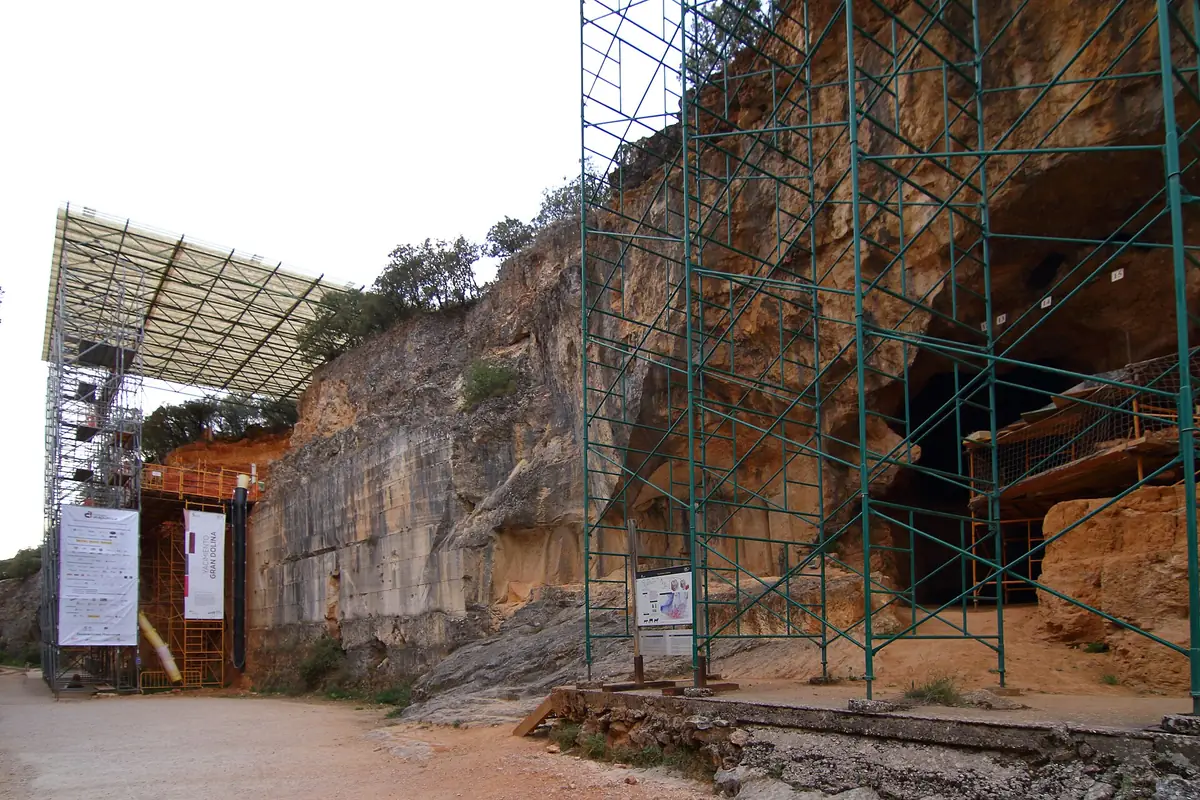
The best early evidence comes from level TD6 at Gran Dolina, in the Sierra de Atapuerca in northern Spain. Here, about 850,000 years ago, lived Homo antecessor, one of the earliest humans known in western Europe.
In 1999, Yolanda Fernández-Jalvo and colleagues showed that many of the human bones carry cut marks, percussion damage and peeling identical to those on the deer, horse and bison bones beside them. Later work identified at least 11 individuals, all children or adolescents. In 2025, excavators reported a neck vertebra from a child aged about two to four with cut marks consistent with removing the head.
The Atapuerca team interprets this as repeated, nutritional cannibalism, perhaps aimed at outsiders from neighbouring groups. The focus on young individuals could reflect raids, since children are easier to capture. That reading is plausible, but motive is always the hardest thing to recover from bones.
Bodo and Krapina: harder cases
Not every cut-marked skull means a meal. The Bodo cranium from Ethiopia, about 600,000 years old, has cut marks around the face and eye sockets. Tim White described them in 1986 as evidence of defleshing. Whether that was for eating or for some mortuary practice is unknown.
At Krapina in Croatia, about 130,000 years old, the Neanderthal bones are heavily broken and some are cut. Early researchers saw cannibalism. Later studies argued that much of the damage came from rockfall, excavation and possibly secondary burial. Krapina is now a contested case.
Neanderthal cannibalism
Several Neanderthal sites show the full butchery package.
- Moula-Guercy, France (~100,000–120,000 years ago). In 1999, Alban Defleur and colleagues reported the remains of at least six Neanderthals, adults and children, processed exactly like the red deer found with them: defleshed, disarticulated and broken for marrow.
- El Sidrón, Spain (~49,000 years ago). Remains of 13 individuals show cut marks and marrow extraction. Ancient DNA suggests the three adult men shared a maternal lineage while the three adult women did not, hinting that women moved between groups. The whole family group seems to have been killed and eaten together.
- Goyet, Belgium (~45,000–40,000 years ago). Neanderthal bones were butchered, and some were then used as tools to retouch stone flakes.
Our article on whether Neanderthals buried their dead covers the other side of Neanderthal treatment of the dead. The same species that ate some bodies carefully buried others.
| Site | Age | Who | Interpretation |
|---|---|---|---|
| Koobi Fora, Kenya (KNM-ER 741) | ~1.45 million years | Unknown hominin | Butchery; species unclear |
| Gran Dolina TD6, Spain | ~850,000 years | Homo antecessor | Repeated nutritional cannibalism |
| Bodo, Ethiopia | ~600,000 years | Middle Pleistocene Homo | Defleshing; motive unknown |
| Moula-Guercy, France | ~100,000–120,000 years | Neanderthals | Butchered like deer |
| El Sidrón, Spain | ~49,000 years | Neanderthals | A family group eaten |
| Gough's Cave, England | ~14,700 years | Homo sapiens | Eating plus ritual skull-cups |
Ice Age skull-cups
Modern humans did it too. At Gough's Cave in Cheddar Gorge, England, about 14,700 years ago, people butchered human bodies and chewed the bones. In 2011, Silvia Bello and colleagues showed that several skulls were carefully cleaned and shaped into cups. A later study found a human arm bone engraved with a zigzag pattern. Here, eating the dead seems to have been bound up with ritual. The site is in the same gorge as Cheddar Man, though he lived several thousand years later.
Was it worth the calories?
In 2017, James Cole estimated the calories in a human body. A 66-kilogram adult man holds about 32,000 kilocalories in skeletal muscle, and about 126,000 in total by his main estimate. A red deer's muscle holds roughly 163,000, and a mammoth's around 3.6 million.
Cole's point was that humans are poor value compared with large game, and dangerous to catch. That makes purely nutritional explanations less likely for many episodes, and pushes motives such as conflict, territorial defence or ritual into the frame. Starvation remains a possibility at some sites.
Did cannibalism leave a mark in our genes?
Among the Fore people of Papua New Guinea, eating the dead as part of funerary rites spread a fatal prion disease, kuru, until the practice ended in the mid-20th century. In 2003, Simon Mead and colleagues argued that a common variant of the human prion gene PRNP, which protects against prion disease, shows signs of balancing selection worldwide. They suggested ancient prion epidemics, perhaps spread by cannibalism. Other geneticists argued the signal was an artefact of how the gene was studied. The idea remains unproven.
Why it matters
Cannibalism forces us to see extinct relatives as complex, not simple. They were capable of the same range of desperate, violent and symbolic behaviour as people today. It also warns against tidy stories: identical cut marks can mean starvation in one cave and reverence in another. To see how these species relate, explore the interactive family tree or compare Homo sapiens and Neanderthals.
Meet the people behind these bones on the interactive deep-time tree of human evolution.
Explore the family tree →Frequently asked questions
What is the oldest evidence of cannibalism?
The oldest clear case is Gran Dolina in Spain, about 850,000 years ago, where Homo antecessor butchered at least 11 children and adolescents. A cut-marked leg bone from Koobi Fora, Kenya, about 1.45 million years old, may be older, but the species involved is uncertain.
Did Neanderthals practise cannibalism?
Yes, at several sites. At Moula-Guercy in France, El Sidrón in Spain and Goyet in Belgium, Neanderthal bones were defleshed and broken for marrow in the same way as animal bones.
Why did early humans eat each other?
Reasons probably varied: hunger, conflict with other groups and funerary ritual. Calorie estimates suggest humans were poor food compared with large game, which makes social or ritual motives likely at many sites.
Did modern humans practise cannibalism in the Ice Age?
Yes. At Gough's Cave in England, about 14,700 years ago, Homo sapiens butchered human bodies and shaped several skulls into cups, suggesting a ritual element.
- Pobiner, B. L., Pante, M. & Keevil, T. (2023). 'Early Pleistocene cut marked hominin fossil from Koobi Fora, Kenya.' Scientific Reports 13. doi.org
- Fernández-Jalvo, Y. et al. (1999). 'Human cannibalism in the Early Pleistocene of Europe (Gran Dolina, Sierra de Atapuerca, Burgos, Spain).' Journal of Human Evolution 37: 591–622. doi.org
- Defleur, A. et al. (1999). 'Neanderthal cannibalism at Moula-Guercy, Ardèche, France.' Science 286: 128–131. doi.org
- Cole, J. (2017). 'Assessing the calorific significance of episodes of human cannibalism in the Palaeolithic.' Scientific Reports 7: 44707. doi.org