The Homo naledi burial question is one of paleoanthropology's hottest disputes. The Rising Star team claims this small-brained hominin deliberately buried its dead in pits dug into a cave floor — and even carved engravings nearby — around 240,000 years ago, despite a brain only about a third the size of ours. Many researchers counter that the evidence isn't yet conclusive, so treat the claim as genuinely contested, not settled.
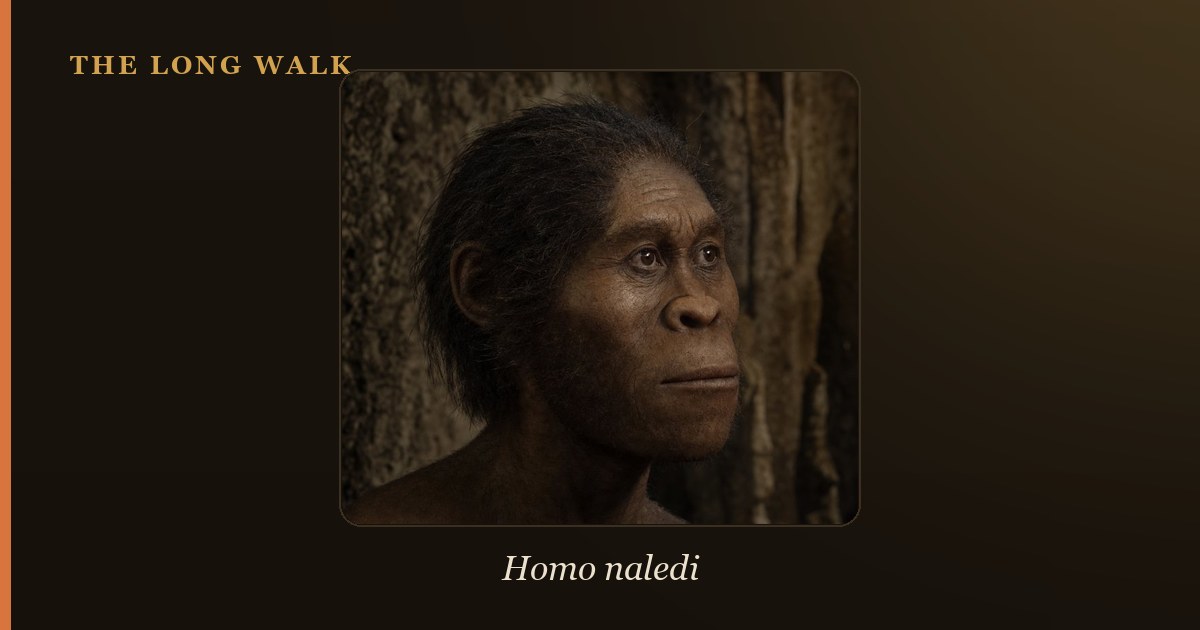
To reach the bones, you crawl through a gap barely 18 centimetres wide, drop down a jagged chute in total darkness, and emerge in a chamber that may never have seen daylight. Down here, in 2013, cavers found the richest single trove of hominin fossils ever recovered in Africa — and, a decade later, the centre of a claim that has split the field. The Homo naledi burial hypothesis holds that a creature with a brain smaller than a chimpanzee's deliberately carried its dead into this remote chamber and buried them.
That idea collides with a deep assumption. Complex treatment of the dead — digging a grave, returning to a place of meaning, perhaps marking it with symbols — has long been read as a signature of large-brained humans: us, and to some degree the Neanderthals. Homo naledi had none of that brain volume. So either a small-brained hominin did something we thought required a big brain, or the cave is fooling us. Both possibilities are extraordinary, and the science is not yet finished sorting them out.
| Deliberate burial: the claim vs the skeptics | Rising Star team | Skeptics |
|---|---|---|
| The claim | Homo naledi intentionally interred bodies in pits dug into the cave floor | Bodies accumulated through natural processes, not deliberate burial |
| Evidence cited | Body-shaped depressions, disturbed sediment, articulated remains, possible grave fill | Stratigraphy and feature outlines not yet demonstrated as dug graves |
| Main objection | — | Sediment slumping, water action, caching, or repeated dumping could mimic graves |
| Dating | Deposits ~241,000–335,000 years old (Dirks et al. 2017) | Dating of the deposits is accepted; timing of any "burial" event is not pinned down |
| Brain size | ~465–610 cc — yet capable of mortuary behaviour | Such a small brain makes the claim require especially strong proof |
| Status | Argued in 2023 preprints; defended in open peer review | Reviewers and outside experts say evidence is not yet conclusive |
The Rising Star discovery
Homo naledi was announced in 2015 by a team led by Lee Berger, after recovery of more than 1,500 fossil specimens from the Dinaledi Chamber of the Rising Star cave system in the Cradle of Humankind, South Africa. The haul represented at least 15 individuals — infants, juveniles, adults, and the elderly — making it one of the largest assemblages of a single hominin species anywhere in the world.
The anatomy was a mosaic. Homo naledi combined surprisingly modern-looking hands and feet with a primitive, flared pelvis and curved fingers suited to climbing. It stood roughly 1.4 metres tall and was lightly built. Most striking of all was the head: an endocranial volume of only about 465 to 610 cubic centimetres, roughly a third of the modern human average and within the range of Australopithecus. You can see where it sits among our relatives on the Homo naledi species page and the interactive deep-time family tree.
Then came the twist that turned a strange fossil into a profound one. When the deposits were finally dated in 2017, they came in at just 241,000 to 335,000 years ago — far younger than the small brain implied. That places Homo naledi in the same African landscape, and the same broad window, as the earliest members of our own species, Homo sapiens.
The burial claim
The remoteness of the Dinaledi Chamber demanded an explanation. How did so many bodies — and almost nothing else, few animal bones, no clear evidence of a flood washing them in — end up in a pitch-black space reachable only through a brutal squeeze? From early on, the Rising Star team argued that the most likely answer was deliberate body disposal: Homo naledi carrying its dead into the chamber on purpose.
In 2023, Berger and colleagues went further. In a set of preprints, they reported what they interpreted as actual graves: body-shaped depressions cut into the cave floor, filled with disturbed sediment, containing partly articulated skeletons in flexed positions. If the team is right, these would be the oldest known intentional burials on Earth — predating documented Homo sapiens and Neanderthal burials by roughly 100,000 years, and carried out by a hominin with a fraction of the brainpower once thought necessary.
It is worth being precise about what is and isn't disputed. That many Homo naledi bodies reached a near-inaccessible chamber is well documented. How they got there — and specifically whether anyone dug a grave — is the contested part.
Engravings and fire?
Alongside the burial preprints, the team described two further claims that raised the stakes. The first was a set of engravings: deliberate, abstract markings — cross-hatching and geometric shapes — scratched into the dolomite walls and pillars near the burial features. Engravings are usually treated as a form of symbolic behaviour, the kind of mark-making associated with cognitively modern humans.
The second was the possible controlled use of fire: charcoal, burnt bone, and soot-darkened surfaces reported within the cave system, hinting that Homo naledi may have brought light into the dark to navigate and perhaps to work. Taken together, burial, engraving, and fire would sketch a portrait of a small-brained hominin with a rich behavioural repertoire.
But these claims face the same problem as the graves, only sharper. Engravings are hard to date directly, and showing that Homo naledi — rather than a later visitor — made them requires linking the marks to the right layers and time. The fire evidence, likewise, must be tied securely to Homo naledi activity rather than to natural processes or later intrusions. None of that has yet been established to most specialists' satisfaction.
Why it is so controversial
The intensity of the debate comes down to two things: how the claims were released, and how strong the alternative explanations are.
The 2023 findings first appeared as non-peer-reviewed preprints, accompanied by a Netflix documentary and heavy press coverage, before the scientific community had vetted them. When the work entered eLife's open peer-review format, the reviews were unusually pointed. Several reviewers and outside experts concluded that the data presented did not yet demonstrate deliberate burial — that the strongest interpretation had been advanced ahead of the strongest evidence.
The scientific objection is concrete. Critics argue that the appearance of a grave can arise without anyone digging one:
- Sediment slumping and water action can rework cave deposits, creating depressions and concentrating bones in ways that mimic deliberate features.
- Caching or repeated dumping of bodies in the same spot can produce dense, partly articulated accumulations without any digging.
- Stratigraphy — the layered record that would show a pit cut into older sediment and refilled — has not, skeptics say, been documented clearly enough to prove a grave was excavated.
In short, the critics are not claiming the burial hypothesis is impossible. They are saying it has not yet been proven, and that natural taphonomic processes remain a live alternative. Until the stratigraphy, dating, and feature geometry are demonstrated to a high standard, the honest verdict is unresolved.
Why a small brain makes it extraordinary
Every part of this debate is amplified by one number: that endocranial volume of roughly 465 to 610 cc. For more than a century, paleoanthropology leaned on a rough equation between brain size and behavioural complexity. Big brains meant tool cultures, symbolism, planning for the future — and care for the dead. Small brains meant something more like other apes.
Deliberate burial sits near the top of that complexity ladder. It implies recognising death, feeling something about it, choosing a place, and acting collectively to treat a body with intent. To find that behaviour in a hominin whose brain overlaps with Australopithecus — not with us — would mean the link between brain size and behaviour is far looser than the textbooks assume. It would suggest that the organisation of a brain, not just its volume, can carry sophisticated behaviour.
This is exactly why the bar for evidence is so high. An ordinary claim about a large-brained species would attract less scrutiny; an extraordinary claim about a small-brained one rightly attracts more. The skeptics are not being unfair in demanding rigorous proof — they are applying the standard that any field-changing result deserves.
Why it matters
The Homo naledi burial question matters because of what hangs on the answer. If the Rising Star team is right, complex mortuary behaviour and symbolic mark-making are not the exclusive property of large-brained humans — they evolved earlier, or more than once, in surprising places. The story of how we became cognitively human would have to widen to include a small-brained cousin crawling through the dark with its dead.
If the skeptics are right, the cave is teaching a different but equally valuable lesson: that natural processes can counterfeit intention, and that the most exciting interpretation is not always the correct one. Either way, the case is a model of how science is supposed to work — bold hypothesis, hard scrutiny, and a willingness to say "not yet proven" while the work continues. For now, the only defensible position is to hold both possibilities open and watch the evidence.
See where Homo naledi sits among our relatives — and how a small-brained hominin could share the landscape with early Homo sapiens — on the interactive deep-time tree.
Explore the family tree →Frequently asked questions
Did Homo naledi bury its dead?
The Rising Star team argues that it did, about 240,000 years ago, by digging pits in the cave floor. Many other researchers say the evidence does not yet rule out bodies settling naturally, so the claim remains unresolved.
Engravings and fire?
The same team reported cross-hatched and geometric markings on the cave walls and traces of fire, and linked both to Homo naledi. Critics say neither has been securely dated or tied to that species.
- Berger, L. R. et al. (2015). "Homo naledi, a new species of the genus Homo from the Dinaledi Chamber, South Africa." eLife 4:e09560. elifesciences.org
- Dirks, P. H. G. M. et al. (2017). "The age of Homo naledi and associated sediments in the Rising Star Cave, South Africa." eLife 6:e24231 (dating to ~236,000–335,000 years ago). elifesciences.org
- Berger, L. R. et al. (2023). "Evidence for deliberate burial of the dead by Homo naledi" and "241,000 to 335,000 year old rock engravings made by Homo naledi" — released as bioRxiv preprints and later in eLife's open peer-review format; both drew significant peer critique. biorxiv.org
- Martinón-Torres, M. et al. and eLife reviewers (2023–2024). Critical commentary and peer reviews concluding the evidence for deliberate burial is not yet conclusive. doi.org/10.7554/eLife.89106