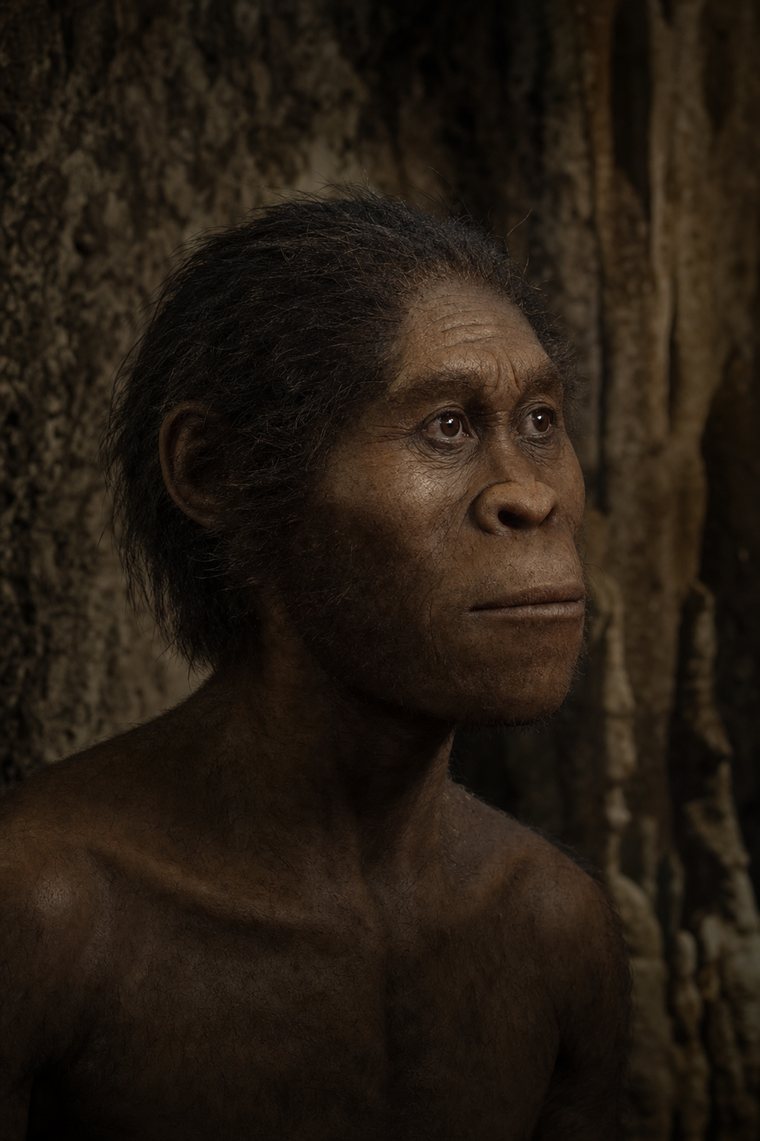
Homo naledi
A tiny-brained human that survived into our own age — and may have buried its dead in the dark.
Overview
Homo naledi stunned the world twice: first in 2015, when more than 1,500 fossil pieces from at least 15 individuals were recovered from a nearly inaccessible chamber of South Africa's Rising Star cave; then again when it was dated to just 335,000–236,000 years ago — astonishingly recent for so small-brained a species.
It means a chimpanzee-brained human relative was alive at the same time as the earliest Homo sapiens.
Anatomy & Body
H. naledi is a true mosaic. Its hands, wrists and feet are remarkably human-like and well suited to walking and manipulating objects, while its shoulders, curved fingers and flared pelvis are more primitive and australopith-like. It was small and slender, averaging about 144 cm tall.
Brain & Cognition
Brain volume was only 465–610 cc — roughly a third of ours — yet endocasts show a humanlike frontal-lobe shape and asymmetry. Its second molars also erupted late, hinting at a slow, humanlike pace of growing up.
The combination of a tiny brain with possibly complex behaviour challenges the assumption that big brains are required for sophisticated culture.
Behavior & Culture
The site itself is the controversy: the remains lie deep in a chamber reachable only through tight, dark passages, with little sign of natural transport or predators. The discovery team argues for deliberate body disposal, and has reported possible engravings and fire use — claims that remain hotly debated and not yet fully accepted.
Key Fossils
- Dinaledi chamber assemblage — over 1,500 specimens, one of the richest hominin troves in Africa.
- LES1 (“Neo”) — a well-preserved skull from the separate Lesedi chamber.
Relationship to Us
H. naledi is an evolutionary cousin, not an ancestor — a separate small-brained lineage that persisted in southern Africa alongside our own emerging species.
Discovery & history
In September 2013 two recreational cavers, Rick Hunter and Steven Tucker, squeezed through a vertical fissure in the Rising Star cave system north-west of Johannesburg and found a chamber floor scattered with bone.
The access problem shaped everything that followed. The final approach — the "Superman's Crawl", a jagged climb called the Dragon's Back, and a chute about 18 cm wide at its narrowest — excluded most people on physical grounds. Lee Berger advertised on Facebook for excavators who were qualified scientists, small enough to fit, and willing to work in those conditions. Six were selected, all women, and the press named them the "underground astronauts".
They recovered over 1,500 specimens from at least fifteen individuals — one of the richest hominin assemblages ever found in Africa. The species was described in eLife in 2015.
The dating, published in 2017, was the real shock. Everyone had assumed that a brain of 465–610 cc meant great antiquity. Instead the fossils dated to 335,000–236,000 years ago, contemporary with the earliest Homo sapiens. A second chamber, Lesedi, produced the well-preserved skull LES1, nicknamed "Neo".
Debates & open questions
How did the bodies get there, and was it deliberate? This is one of the sharpest active disputes in the field. The remains lie deep inside a chamber with no evidence of natural water transport, no carnivore damage, and no sign that the passage was ever easier to negotiate. The discovery team argues the only remaining explanation is that H. naledi carried its dead into the dark on purpose.
In 2023 the team went considerably further, posting preprints claiming deliberate burial in dug graves, deliberate engravings on the cave walls, and controlled use of fire. eLife's assessment process published the peer reviews alongside the papers, and the reviews were unusually blunt: reviewers judged the sedimentological evidence for intentional burial to be inadequate and the case unproven. Critics including María Martinón-Torres and Andy Herries have pressed the same point.
Alternative explanations remain on the table — a death trap that repeatedly caught individuals, or gradual accumulation through a route now collapsed — though each has its own difficulties.
Why it matters: mortuary behaviour has long been treated as a marker of large-brained cognition. If a hominin with a third of our brain volume was doing it, that link weakens considerably. The stakes explain the intensity of the argument, and the case is genuinely not closed.