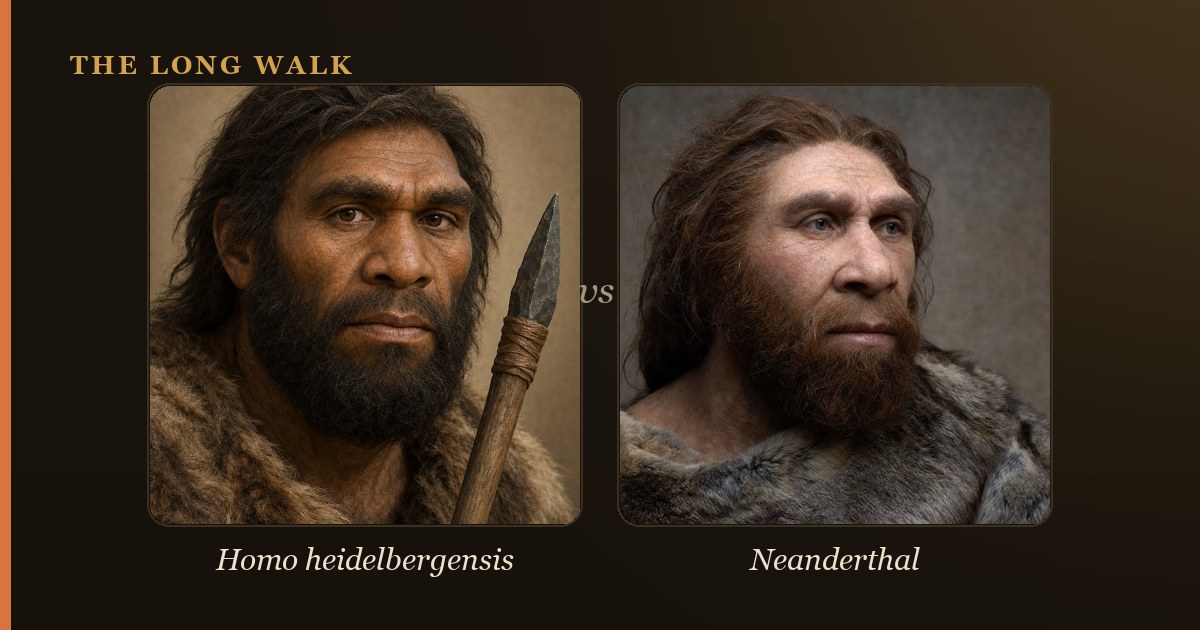
Homo heidelbergensis lived ~700,000–300,000 years ago and is widely seen as the ancestral stock of both Neanderthals and modern humans. European populations of heidelbergensis gradually evolved into Neanderthals through an 'accretion' of cold-adapted traits. The two are best understood not as rivals but as successive stages of one European lineage — though the name heidelbergensis itself is contested.
At Schöningen in Germany, archaeologists recovered a set of finely balanced wooden throwing spears, the oldest complete hunting weapons on Earth. For decades they were dated to 300,000–400,000 years and credited to Homo heidelbergensis. In 2025 the spear layer was re-dated to about 200,000 years, which makes early Neanderthals the likelier makers. That switch shows how hard it is to say where one of these species ends and the other begins.
So how do Homo heidelbergensis vs Neanderthals compare? Unlike most species pairings, this one is less "who won" and more "parent and child." Many researchers think European heidelbergensis simply became the Neanderthals. But the story — and even the name — is more tangled than it looks.
| Homo heidelbergensis and Neanderthals compared | Homo heidelbergensis | Neanderthals |
|---|---|---|
| Lived | ~700,000–300,000 years ago | ~430,000–40,000 years ago |
| Range | Africa, Europe, W. Asia | Europe, W. & Central Asia |
| Brain size | ~1,100–1,400 cc | ~1,410 cc |
| Build | Tall, robust, ~1.75 m | Stocky, cold-adapted, ~1.64–1.68 m |
| Key fossils | Mauer jaw, Kabwe skull, Bodo, Boxgrove | La Chapelle, Shanidar, Krapina |
| Tools | Late Acheulean handaxes; wooden spears | Mousterian (Levallois) flake tools |
| Signature | Huge brow, no chin, big face | Midfacial projection, occipital bun |
| Relationship | Likely ancestor of Neanderthals & us | Descendant of European heidelbergensis |
Who was Homo heidelbergensis?
Homo heidelbergensis takes its name from the Mauer mandible, a heavy, chinless lower jaw found near Heidelberg, Germany, in 1907 and dated to about 609,000 years ago. The species spanned roughly 700,000 to 300,000 years ago and is known from across the Old World: the Kabwe (Broken Hill) skull from Zambia, the Bodo cranium from Ethiopia, the Boxgrove shin bone from England, and the Arago remains from France.
These were big people — robust, tall (around 1.75 m), with brains of 1,100–1,400 cc approaching the modern range, set behind a massive brow and a broad, projecting face. They were accomplished hunters: at Boxgrove in England they butchered horse and rhino, and late Acheulean handaxes mark their toolkit. Many palaeoanthropologists regard heidelbergensis as the last common ancestor of Neanderthals, Denisovans, and ourselves. More on the Homo heidelbergensis page.
Where did heidelbergensis come from? The Homo erectus connection
Heidelbergensis did not appear from nowhere. Its most likely ancestor is Homo erectus, the first hominin to leave Africa — reaching Dmanisi in Georgia, Zhoukoudian in China, and Java in Indonesia from about 1.8 million years ago. Erectus had a near-modern body plan but a smaller brain, averaging around 900 cc, and made Acheulean handaxes (though East-Asian populations kept to simpler choppers, a divide known as the Movius Line).
The step from erectus to heidelbergensis, across roughly 900,000 to 600,000 years ago, is one of the clearest brain-expansion events in our record: cranial capacity climbs from about 900 cc toward 1,200 cc and beyond. With it came cooperative big-game hunting and — at some sites — the controlled use of fire. Put simply, heidelbergensis is roughly what you get when an erectus-grade body is fitted with a near-modern brain. You can place both species on the human evolution timeline.
Who were the Neanderthals?
The Neanderthals (Homo neanderthalensis) were the cold-adapted Europeans who flourished from about 430,000 to 40,000 years ago. Compared with heidelbergensis, they were shorter and stockier, with a distinctive projecting midface, a rounded bulge at the back of the skull (the occipital bun), and a brain averaging around 1,410 cc. They made refined Mousterian tools, buried their dead, and survived repeated glaciations. Full account on the Neanderthal page.
The key differences
The accretion model
The dominant view is that Neanderthal features did not appear all at once but accreted gradually within European heidelbergensis populations across hundreds of thousands of years. The 430,000-year-old skulls from the Sima de los Huesos pit at Atapuerca, Spain — once labelled heidelbergensis — already show clear early Neanderthal traits, and their DNA confirms they sit on the Neanderthal line. In other words, the boundary between the two "species" is a moving target, not a wall.
Anatomy and climate
Heidelbergensis is more generalised; Neanderthals are specialised for Ice Age cold — compact bodies that conserve heat, a large nose to warm air. The Neanderthal face pulls forward; the heidelberg face is broad and flat. Brain sizes overlap, with Neanderthals at the top of the range.
Tools
The shift from late Acheulean handaxes to Mousterian prepared-core flake technology roughly tracks the transition from heidelbergensis to Neanderthals — a change in how stone was worked rather than a sudden leap in capability.
Did they ever meet?
In Europe they grade into one another rather than meeting as separate peoples — late heidelbergensis is early Neanderthal, depending on where you draw the line. African heidelbergensis populations, meanwhile, are thought to have given rise to Homo sapiens. So this is a family tree splitting, not two strangers crossing paths: one ancestral stock in Africa led to us, while its European cousins became the Neanderthals.
Why it matters
This comparison exposes a deep truth about the fossil record: species are human-made boxes imposed on a continuous stream of evolving populations. Heidelbergensis is partly a "wastebasket" name for Middle Pleistocene fossils that are neither clearly Neanderthal nor clearly modern — and that ambiguity is exactly what we'd expect if it is the trunk from which both branches grew. It is, in a real sense, the shared grandparent of every human alive.
A note on names: rhodesiensis, bodoensis, and the "muddle in the middle"
The African side of this story carries its own naming muddle. The Kabwe (Broken Hill) skull from Zambia — redated in 2020 to about 299,000 years old — is often given its own species name, Homo rhodesiensis, yet it looks much like African heidelbergensis. In 2021, Roksandic and colleagues proposed scrapping both labels in Africa in favour of Homo bodoensis (after the Bodo cranium from Ethiopia), reserving heidelbergensis for the European populations that led to Neanderthals. Nothing is settled: the scarcity of ancient DNA from this "muddle in the middle" of the Middle Pleistocene keeps the boundaries blurry, which is why the same skull can be filed under three different species depending on which paper you read.
Follow the European lineage from Homo heidelbergensis to the Neanderthals — and the African branch that leads to us — on the interactive family tree.
Explore the family tree →Frequently asked questions
Who was Homo heidelbergensis?
A Middle Pleistocene human species named after the Mauer jaw, found near Heidelberg in 1907 and dated to about 609,000 years ago. Fossils assigned to it, such as the Kabwe skull from Zambia, span roughly 700,000 to 300,000 years ago.
Who were the Neanderthals?
A cold-adapted human species of Europe and western Asia, from about 430,000 to 40,000 years ago. They were shorter and stockier than Homo heidelbergensis, with a projecting midface and a bulge at the back of the skull.
Did they ever meet?
Not as separate peoples. In Europe, late Homo heidelbergensis grades into early Neanderthals, so where one ends depends on where researchers draw the line. African populations of heidelbergensis are often linked to the origin of Homo sapiens.
Did Homo heidelbergensis evolve from Homo erectus?
Most researchers think so. African Homo erectus, with a brain averaging about 900 cc, is the leading candidate ancestor; by roughly 600,000 years ago heidelbergensis had a brain near 1,200 cc, made wooden throwing spears, and hunted big game cooperatively.
Is Homo rhodesiensis the same as heidelbergensis, and what is Homo bodoensis?
The Kabwe (Broken Hill) skull from Zambia, about 299,000 years old, is often labelled Homo rhodesiensis but closely resembles African heidelbergensis. A 2021 proposal would replace both African labels with Homo bodoensis, keeping heidelbergensis for the European Neanderthal lineage. It remains debated.
- Arsuaga, J. L. et al. (2014). "Neandertal roots: Cranial and chronological evidence from Sima de los Huesos." Science 344. science.org
- Thieme, H. (1997). "Lower Palaeolithic hunting spears from Germany." Nature 385 (Schöningen). nature.com
- Smithsonian Human Origins — Homo heidelbergensis. humanorigins.si.edu