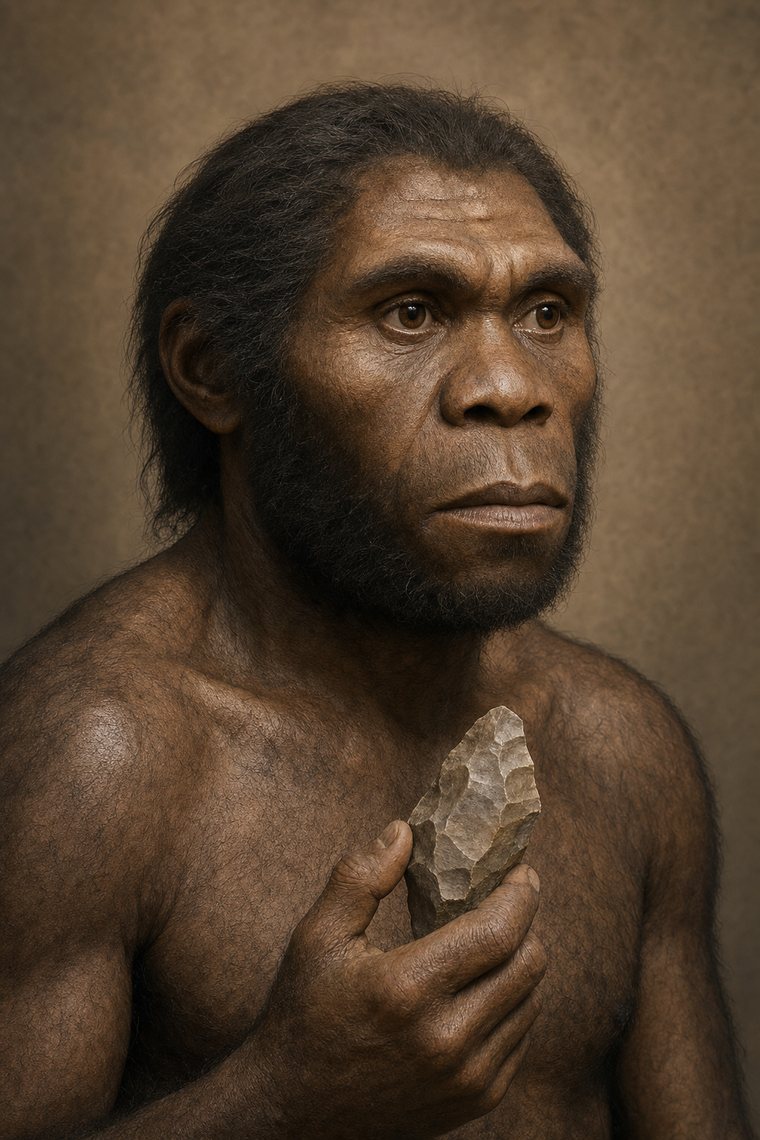
Homo habilis
The first of our own genus — and, perhaps, the first deliberate toolmaker named for it.
Overview
Homo habilis was named 'handy man' because its fossils were found alongside some of the earliest stone tools. Living from roughly 2.4 to 1.5 million years ago, it marks the contested threshold where palaeontologists begin to recognise our own genus, Homo.
Its mosaic anatomy — and overlap with both australopiths and early Homo erectus — keeps it at the centre of debates about what it even means to be 'Homo'.
Anatomy & Body
H. habilis had a larger, rounder braincase and a less projecting face than the australopiths, with smaller teeth. But it kept relatively long arms and a small body, retaining some climbing ability.
Its hand bones suggest a capacity for both powerful and precise grips — useful for making and using tools.
Brain & Cognition
Brain volumes of 510–690 cc represent a clear step up from australopiths. Endocasts hint at expansion in regions associated in modern humans with language, though we cannot know how those areas functioned.
Behavior & Culture
H. habilis is associated with the Oldowan industry — simple but deliberate sharp flakes struck from cores, used to butcher animals and crack bone for marrow. Whether habilis alone made these tools (versus contemporaries) is debated, but the behaviour signals a new reliance on technology.
Key Fossils
- OH 7 — the type specimen from Olduvai Gorge: jaw, skull fragments and hand bones.
- KNM-ER 1813 — a well-preserved small cranium from Koobi Fora, Kenya.
Relationship to Us
H. habilis is generally considered an early member of our genus and a plausible ancestor (or close relative of the ancestor) of Homo erectus — and thus of us.
Discovery & history
In 1960, a year after his mother found "Nutcracker Man" at Olduvai, Jonathan Leakey found something quite different in the same gorge: a lower jaw, hand bones and skull fragments from a lighter-built hominin with a noticeably larger brain. The specimen, OH 7, was known around camp as "Jonny's child".
Louis Leakey, Phillip Tobias and John Napier named the species Homo habilis — "handy man" — in 1964, choosing the name because they believed this was the maker of the Oldowan stone tools found throughout the deposits.
The naming was genuinely radical. At the time, membership of genus Homo was widely held to require a brain above a threshold of roughly 750 cc, sometimes called the "cerebral Rubicon". H. habilis, at 510–690 cc, fell below it. Admitting the species to Homo meant abandoning brain size as the defining criterion in favour of behaviour and hand anatomy — a shift that many colleagues resisted for years.
Debates & open questions
Does it belong in Homo at all? Sixty years on, this is still argued. The 1986 discovery of OH 62, a partial skeleton, was awkward for the traditional view: it showed long arms and short legs, body proportions closer to Australopithecus than to later Homo. A number of researchers, including Bernard Wood, have argued the species would be better placed as Australopithecus habilis, leaving Homo to begin with erectus.
Is it one species or two? KNM-ER 1470 from Koobi Fora has a larger braincase and a broader, flatter face than typical habilis material. Many researchers separate it as Homo rudolfensis; others treat the differences as sexual dimorphism within a single variable species. There is no consensus.
Did it actually make the tools? The name says yes; the evidence is less certain. Stone tools now substantially predate the species — the Lomekwi 3 assemblage in Kenya has been dated to about 3.3 million years, well before any Homo. And Paranthropus boisei lived alongside habilis at Olduvai with hands capable of tool use. "Handy man" may have shared its industry with several contemporaries.
A 2.8-million-year-old jaw from Ledi-Geraru, LD 350-1, may push the origin of Homo earlier still.