Hominid = all great apes (family Hominidae): orangutans, gorillas, chimps, bonobos, humans, and their ancestors. Hominin = humans and our fossil relatives after the chimpanzee split (tribe Hominini): Homo, Australopithecus, Ardipithecus, Sahelanthropus, and others. The terminology shifted in the 1990s when molecular DNA showed great apes were one clade. Modern scientific writing uses hominin for the human lineage.
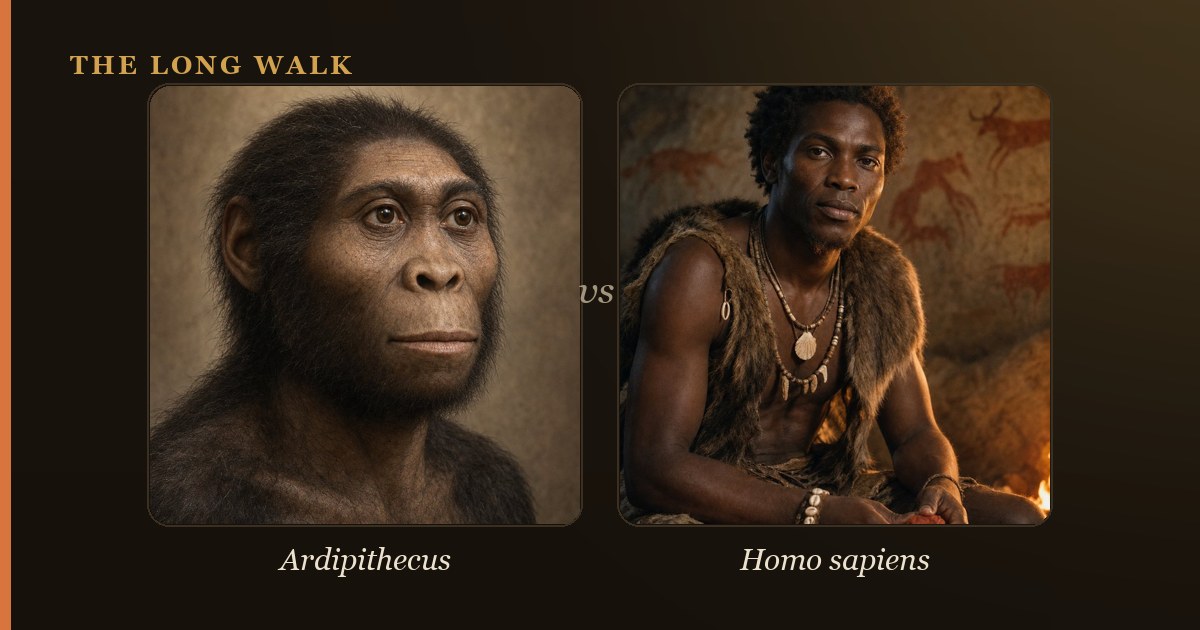
The words "hominin" and "hominid" appear in nearly every paleoanthropology article, and they are almost always used correctly—but only in modern sources. Older textbooks and popular articles often use these terms differently, which creates confusion for students and curious readers. The shift happened gradually over three decades as DNA evidence rewrote our understanding of ape evolution, and the terminology followed.
The key insight is simple: these words mark different branches on the primate family tree. One is broader and includes all great apes; the other is narrower and includes only the human lineage. Once you know which is which, you can confidently read any article about human origins and understand exactly which animals the author is discussing.
| Term | Hominid | Hominin |
|---|---|---|
| Taxonomic rank | Family Hominidae | Tribe Hominini |
| Living members | Orangutans, gorillas, chimps, bonobos, humans | Humans only |
| Fossil members | All great ape ancestors | Human-line ancestors after chimp split |
| Examples | Homo sapiens, Pan troglodytes, Pongo pygmaeus, Australopithecus afarensis | Homo sapiens, Australopithecus, Ardipithecus, Sahelanthropus |
| Scientific standard since | 1950s onward | 1990s onward (major shift) |
| What it means in plain English | All great apes and their ancestors | Humans and our extinct relatives on our side of the tree |
The Quick Definitions
Hominid refers to the family Hominidae—the broadest category. It includes all living great apes (orangutans, gorillas, chimpanzees, bonobos, and humans) plus every ancestor they share back to the split between apes and Old World monkeys, roughly 25 million years ago. If you want to talk about all the great apes collectively, use hominid.
Hominin refers to the tribe Hominini—a much narrower group. It includes only humans (Homo sapiens) and fossil species that walked upright on the human side of the family tree after we diverged from chimpanzees, roughly 6 to 7 million years ago. When paleoanthropologists discover a new fossil and ask “Is this a hominin?” they are asking whether it belongs to the human lineage specifically, not just anywhere in the great ape family.
Hominid: The Great-Ape Family
The term hominid is the older of the two and has remained stable in modern taxonomy. Family Hominidae is one of the major clades (evolutionary groups) in the primate order, recognized since the 19th century. It sits alongside other families like Cercopithecidae (Old World monkeys) and Hylobatidae (gibbons, the lesser apes).
All living hominids are endangered or declining in the wild. Orangutans survive in fragmented rainforests of Borneo and Sumatra. Gorillas live in central African forests. Chimpanzees and bonobos are restricted to equatorial Africa, while humans have colonized every continent. When you read that a fossil ape “is the earliest hominid,” it means that fossil is the oldest member of the great-ape clade that we have found so far.
Hominin: The Human Branch
The term hominin is newer and narrower. It refers to a specific tribe within the family Hominidae—tribe Hominini, which includes all the upright-walking apes that evolved after our split from the common ancestor we shared with chimpanzees. Hominin species include the familiar names: Homo sapiens (us), Homo neanderthalensis (Neanderthals), Homo erectus, Australopithecus afarensis (Lucy), and Ardipithecus ramidus.
More distantly related hominins include genera like Sahelanthropus, Orrorin, and Kenyanthropus—all discovered in the last 25 years and all older than the better-known Australopithecus. The defining trait that unites all hominins is upright walking (bipedalism), which set our ancestors apart from apes even when their brains and teeth were still very ape-like. You can think of hominins as “the human family tree,” while hominids are “the great-ape family tree.”
Why the Terms Changed: Molecular Evidence and Cladistics
For most of the 20th century, scientists used the word hominid to mean what we now call hominin. Older biology textbooks call humans and our fossil relatives “hominids,” which is technically wrong by modern standards. The shift happened gradually in the 1990s and early 2000s, driven by two revolutions in biology: molecular clocks and cladistic taxonomy.
DNA studies in the 1970s and 1980s showed that humans and African great apes (gorillas and chimpanzees) are more closely related to each other than any of them are to orangutans. In fact, we share a more recent common ancestor with chimps than chimps share with gorillas. This genetic evidence contradicted the old assumption that great apes formed one clade and humans stood apart. Cladistic taxonomy, which groups organisms by shared ancestry, demanded a new classification: all great apes plus humans belong in one family (Hominidae), while the human lineage alone belongs in tribe Hominini.
The result was systematic: orangutans were moved from a separate family into Hominidae alongside gorillas, chimps, and humans. The old term “hominid” now applied to this larger group. Scientists needed a new term for the human-only branch, so they adopted hominin, which had been used sporadically since the 1960s but never widely. By the 2000s, this terminology became standard in academic literature and is now taught in every university paleoanthropology course.
Hominoid and Hominine: The Related Terms
Two more technical terms often appear alongside hominid and hominin, so it is worth learning them too. Hominoid (superfamily Hominoidea) is even broader than hominid—it includes all apes, both great apes and the lesser apes (gibbons). If you want to refer to all apes collectively, without specifying great or small, hominoid is the right choice.
Hominine (subfamily Homininae) is almost as narrow as hominin but not quite. It includes the African great apes (gorillas, chimps, and bonobos) and all hominins, but excludes orangutans. So while a hominin is always a hominoid and always a hominid, a hominine might or might not be a hominin depending on whether it is an African ape or specifically on the human line. These distinctions matter when comparing human evolution to ape evolution, especially when discussing when particular traits (upright walking, reduced canine teeth, larger brains) first appeared.
Which Word Should You Use?
If you are writing about human evolution or fossil humans, use hominin. This is the modern standard and will be immediately recognized by anyone with recent scientific training. If you are writing about all great apes together (both living and fossil), use hominid. Reserve hominoid for contexts where you want to include gibbons and other lesser apes.
When reading older sources from before the 1990s, mentally translate “hominid” to “hominin” if the text is clearly about the human lineage. When reading modern scientific papers, trust that the author has used the terms correctly—if they say hominin, they mean human lineage; if they say hominid, they mean all great apes. This simple habit will eliminate most confusion. The taxonomy itself is now settled, and it reflects what DNA has taught us: humans are not separate from the great apes, but rather one twig on a tree we share with them.
Understanding these terms opens the door to deeper reading in paleoanthropology. When you encounter a fossil with an unfamiliar name, knowing whether it is a hominid, hominin, or hominoid tells you instantly where it sits on the primate tree. And that matters, because the story of human origins is the story of how one small branch of the great-ape clade became us.
See exactly which branches of the primate tree count as hominins on the interactive family tree.
Explore the family tree →Frequently asked questions
What is the difference between Hominin and Hominid?
Hominid covers all great apes, living and extinct, including humans. Hominin is narrower: it covers only humans and fossil relatives on our side of the split from chimpanzees, such as Australopithecus and Homo.
Which Word Should You Use?
Use hominin for humans and our fossil relatives after the chimpanzee split, which is the standard term in current research. Use hominid only when you mean the great apes as a whole.
- Smithsonian Human Origins — Human family tree. humanorigins.si.edu
- Britannica — Hominin. britannica.com
- Wood, B. & Harrison, T. (2011). 'The evolutionary context of the first hominins.' Nature 470. nature.com