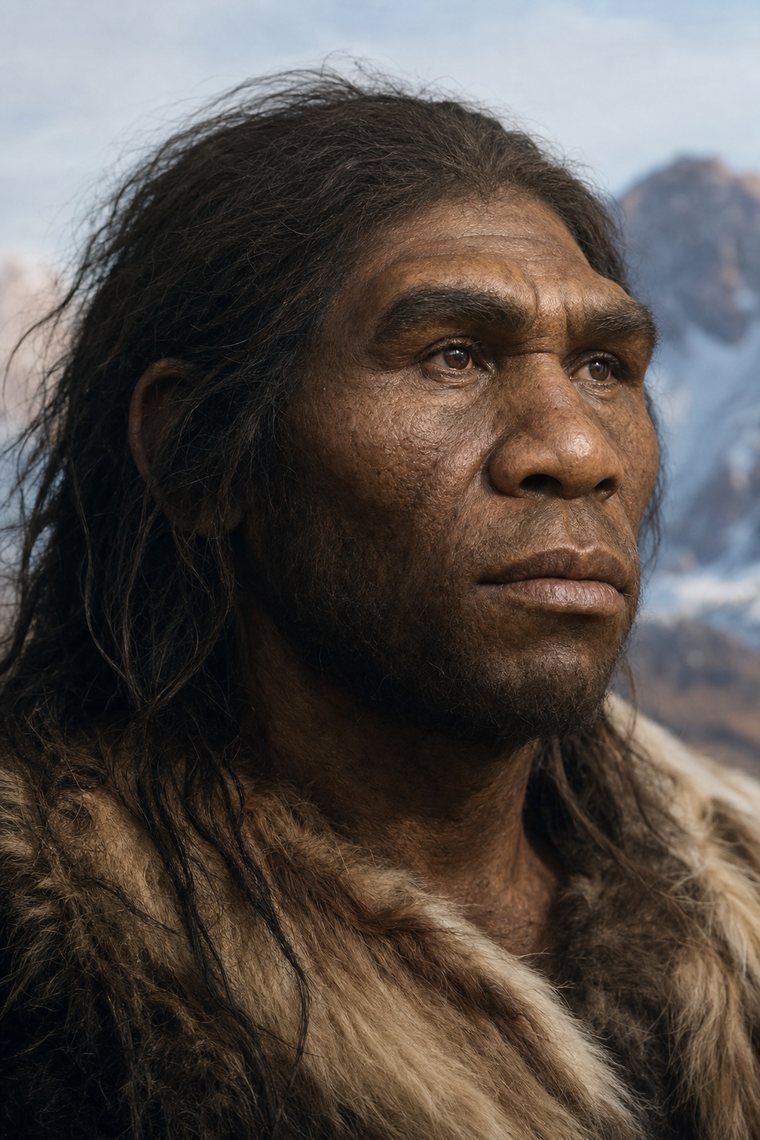
Denisovans
A whole human species first discovered not from a skull, but from a fingertip's DNA.
Overview
The Denisovans are unique in human palaeontology: they were identified in 2010 not from a recognisable skeleton, but from DNA extracted from a tiny finger bone in Siberia's Denisova Cave. The genome revealed a previously unknown sister group to the Neanderthals.
For years they were a 'genome in search of a face'. Newer fossils — especially from the Tibetan Plateau — are slowly giving them one.
Anatomy & Body
Direct skeletal evidence remains sparse: a finger bone, teeth, a jaw from Tibet (Xiahe), and likely a partial skull from Harbin, China (the 'Dragon Man'). The robust jaw and very large molars suggest a powerfully built archaic human, but a complete picture is still missing — much of our knowledge is genetic rather than anatomical.
Brain & Cognition
Brain size is not directly known, but given their close kinship with Neanderthals and large-bodied appearance, Denisovans likely had large brains. They occupied a vast range of harsh environments, from Siberian cold to the high, thin air of the Tibetan Plateau.
Behavior & Culture
Denisovan-layer deposits at Denisova Cave include bone tools and personal ornaments, though it is not always certain which hominin made them given that Neanderthals and modern humans also used the cave. Their adaptation to high altitude is one of the most striking stories in human genetics.
Genetics & Legacy
Modern humans interbred with Denisovans too. Their DNA survives most strongly in Oceanian peoples (Papua New Guineans and Aboriginal Australians carry several percent), and in Tibetans the Denisovan-derived EPAS1 gene variant enables life at high altitude with low oxygen — a textbook case of adaptive introgression. Recent work suggests some East Asian fossils once called Denisovan may belong to newly proposed groups such as Homo juluensis ('big head'), and the link to the 'Dragon Man' (H. longi) is actively debated.
Discovery & history
Denisovans are the first human population ever identified from genetics rather than anatomy — a reversal of how palaeoanthropology had worked for a century and a half.
In 2008 a Russian team excavating Denisova Cave in Siberia's Altai Mountains recovered the tip of a juvenile finger bone. Morphologically it was unremarkable; it could have belonged to almost anyone. In 2010, Svante Pääbo's group in Leipzig sequenced first its mitochondrial DNA and then its nuclear genome, and found a lineage that was neither modern human nor Neanderthal, but a sister group to Neanderthals that had split from them several hundred thousand years earlier.
A whole population had been discovered from a fragment the size of a fingernail. Work by Pääbo on archaic genomes was recognised with the 2022 Nobel Prize in Physiology or Medicine.
Later finds extended the range enormously. The Xiahe mandible from Baishiya Karst Cave on the Tibetan Plateau, identified in 2019 through ancient protein analysis rather than DNA, showed Denisovans living at 3,280 m. And "Denny" — Denisova 11, published in 2018 — turned out to be a first-generation hybrid: a Neanderthal mother and a Denisovan father.
Debates & open questions
They still have no formal species name. Under the naming conventions of zoology a new species needs a described type specimen, and the physical remains — a finger bone, a few teeth, some fragments and the Xiahe jaw — have been considered too scant to diagnose one. So "Denisovan" remains an informal population label rather than a Latin binomial, an odd status for a group we know a great deal about genetically.
What did they look like? Largely unknown. Their molars are unusually large; beyond that, most reconstructions lean heavily on inference from DNA methylation patterns rather than fossils.
Is "Dragon Man" a Denisovan? A very large, well-preserved skull from Harbin in northeast China, named Homo longi in 2021, was proposed as a possible Denisovan on morphological grounds. Subsequent molecular work on the specimen has strengthened that identification considerably. If it holds, we finally have a Denisovan face.
How many lineages were there? Genomic evidence points to at least three distinct Denisovan-related populations contributing to living people at different times, with the highest inherited proportions — around 4–6% — in Papuans and Aboriginal Australians. Whether Homo luzonensis in the Philippines belongs anywhere in this picture is unknown.
Their most consequential legacy is medical: the EPAS1 variant that allows Tibetans to function at altitude without dangerously thickening their blood came from Denisovan ancestors.