The world's oldest cave art with a secure date is a hand stencil in Liang Metanduno cave on Muna Island, Sulawesi, Indonesia, made at least 67,800 years ago (published January 2026). The oldest figurative scene, people and a pig, is at least 51,200 years old, also on Sulawesi. Red marks in three Spanish caves are dated to more than 64,000 years ago and may be Neanderthal work, though that claim is still debated.
On a cave wall on Muna, a small island off southeast Sulawesi, there is a faded patch of red pigment about 14 by 10 centimetres. It is part of a hand stencil, made by spraying pigment around a hand pressed against the rock. A thin crust of calcite later grew over it. In January 2026, a team led by Adhi Agus Oktaviana, Maxime Aubert and Adam Brumm reported that the crust is at least 67,800 years old, so the stencil beneath must be older still.
That makes it the world's oldest cave art with a secure minimum date. Ask most people where cave art began and they say Lascaux or Chauvet in France. The record now points to tropical Asia, and possibly to another human species in Spain.
How cave art is dated
Most early rock art contains no organic material, so radiocarbon dating cannot be used. Instead, researchers date the mineral crusts that form on top of the paint.
Water seeping through limestone deposits thin layers of calcite. That calcite traps tiny amounts of uranium, which decays into thorium at a known rate. Measuring the ratio gives the age of the crust. Because the crust formed after the painting, this uranium-series dating gives a minimum age: the art is at least that old, and possibly much older.
The Muna team used a refined method, laser-ablation uranium-series dating, which samples the crust layer by layer down towards the pigment. This reduces the risk of mixing younger and older calcite. Our guide to how scientists date fossils explains the wider family of methods.
Sulawesi: the world's oldest cave art gallery
The Indonesian record has been rewritten step by step since 2014:
- 2014: Hand stencils at Leang Timpuseng, in the Maros-Pangkep karst of southwest Sulawesi, dated to at least 39,900 years, as old as the oldest art in Europe.
- 2018: An animal painting in Lubang Jeriji Saléh, Borneo, dated to at least 40,000 years.
- 2019: A hunting scene at Leang Bulu' Sipong 4, with part-human figures facing wild pigs and dwarf buffalo, dated to at least 43,900 years.
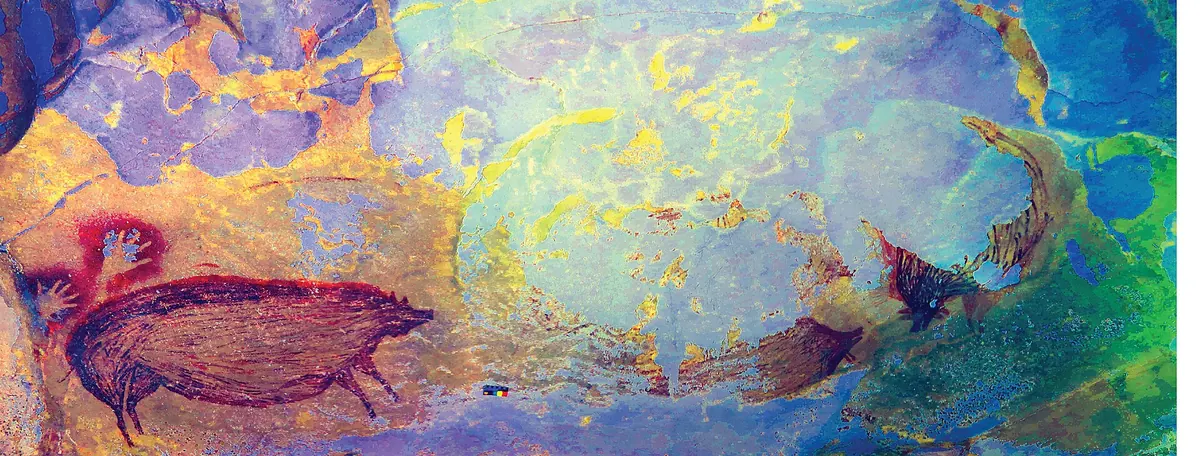
- 2021: A life-sized warty pig at Leang Tedongnge dated to at least 45,500 years.
- 2024: A scene at Leang Karampuang showing three human-like figures interacting with a pig, dated to at least 51,200 years. It is the oldest known figurative art and the oldest known visual narrative.
- 2026: The Muna hand stencil, at least 67,800 years old.
The Muna stencil has another detail: the tip of one finger appears to have been deliberately narrowed, either by adding pigment or by moving the hand. That style is known only from Sulawesi, which suggests a local tradition lasting tens of thousands of years.
Why hand stencils come first
Hand stencils are among the oldest forms of cave art on several continents, and they stayed popular for tens of thousands of years. They need no drawing skill: a mouthful of pigment, a hand and a wall. That simplicity may explain why they turn up so widely.
Examples span the world and the Ice Age. Gargas in the French Pyrenees has more than 200 stencils, many apparently with missing finger segments, about 27,000 years old. Cueva de las Manos in Patagonia, Argentina, has hundreds of overlapping stencils roughly 9,000 years old. Whether the missing fingers at Gargas record injuries, frostbite or folded fingers used as signals is still argued.
What all stencils share is a direct physical trace of a person. Measuring hand size even lets researchers estimate whether adults or children made them, and studies of finger-length ratios have tried, with mixed success, to tell men's hands from women's.
Did Neanderthals paint first?
In 2018, Dirk Hoffmann and colleagues dated calcite crusts over red marks in three Spanish caves:
- La Pasiega (Cantabria): a ladder-like red shape, at least 64,800 years old.
- Maltravieso (Extremadura): a hand stencil, at least 66,700 years old.
- Ardales (Andalusia): red pigment on cave formations, at least 65,500 years old.
Modern humans did not reach Iberia until roughly 42,000 years ago, so if the dates are right, the artists were Neanderthals.
The claim is contested. Critics, including Randall White and colleagues in 2020, argue that uranium can leach out of calcite and make crusts look older than they are. They also say some marks may be natural staining. In 2021, Africa Pitarch Martí and colleagues showed that the Ardales pigment was applied deliberately and does not match natural iron deposits in the cave, which strengthens the case for at least that site. The Neanderthal attribution remains plausible but not settled.
The Muna stencil beats the Maltravieso minimum by about 1,100 years. Both are minimum ages, though, so neither can be called "first" with confidence.
| Site | Minimum age | Type | Likely maker |
|---|---|---|---|
| Liang Metanduno, Muna (Indonesia) | 67,800 years | Hand stencil | Homo sapiens |
| Maltravieso (Spain) | 66,700 years | Hand stencil | Neanderthals (debated) |
| La Pasiega (Spain) | 64,800 years | Red linear sign | Neanderthals (debated) |
| Leang Karampuang (Indonesia) | 51,200 years | Figurative scene | Homo sapiens |
| Leang Tedongnge (Indonesia) | 45,500 years | Pig painting | Homo sapiens |
| El Castillo (Spain) | 40,800 years | Red disk | Debated |
| Chauvet (France) | ~36,000 years | Animal paintings | Homo sapiens |
Older than painting: engravings, beads and ochre
Painting on cave walls is the most visible form of early symbolism, but not the oldest.
- Blombos Cave, South Africa: engraved ochre pieces about 75,000–100,000 years old, and a cross-hatched red drawing on a stone flake about 73,000 years old, described by Christopher Henshilwood and colleagues in 2018.
- Cueva de los Aviones, Spain: perforated, pigment-stained shells about 115,000 years old, attributed to Neanderthals.
- Trinil, Java: a freshwater shell with a zigzag engraving, about 430,000–540,000 years old, probably made by Homo erectus.
Whether a single zigzag counts as "art" is a matter of definition. It does show that deliberate mark-making goes back much further than cave painting. Our article on Venus figurines covers the later explosion of portable art in Ice Age Europe.
What the Muna stencil says about migration
The Muna date also matters for human dispersal. Sulawesi lies in Wallacea, the island zone between Asia and Australia that was never joined to either continent by land. Reaching it required sea crossings. A stencil made at least 67,800 years ago means modern humans were already island-hopping through the region by then. The authors argue this supports a northern route into Sahul (Australia and New Guinea) about 65,000 years ago, a topic covered in when humans reached Australia.
Why it matters
The oldest art challenges two old assumptions: that Europe was the cradle of human creativity, and that symbolic thought belonged only to our species. Art appears early at both ends of Eurasia, and possibly in Neanderthal hands. The dates will keep moving as more crusts are sampled, because every result is a minimum. Explore when each human species lived on the interactive family tree.
Meet the human species who may all have been artists on the interactive family tree.
Explore the family tree →Frequently asked questions
What is the oldest cave art in the world?
A hand stencil in Liang Metanduno cave on Muna Island, Sulawesi, Indonesia, dated to at least 67,800 years ago. The oldest dated scene with figures, people and a pig, is at Leang Karampuang on Sulawesi and is at least 51,200 years old.
Did Neanderthals make cave art?
Possibly. Red marks and a hand stencil in three Spanish caves are dated to more than 64,000 years ago, before modern humans reached Europe. Some researchers question the dating, so the claim is plausible but not settled.
Is the oldest cave art in France?
No. Chauvet, about 36,000 years old, and Lascaux, about 17,000 years old, are famous but much younger than the oldest art in Indonesia and Spain.
How do scientists date cave paintings?
Usually by uranium-series dating of calcite crusts that formed on top of the paint. Because the crust formed later, the result is a minimum age for the art underneath.
- Oktaviana, A. A. et al. (2026). 'Rock art from at least 67,800 years ago in Sulawesi.' Nature 650: 652–656. doi.org
- Oktaviana, A. A. et al. (2024). 'Narrative cave art in Indonesia by 51,200 years ago.' Nature 631: 814–818. doi.org
- Hoffmann, D. L. et al. (2018). 'U-Th dating of carbonate crusts reveals Neandertal origin of Iberian cave art.' Science 359: 912–915. doi.org
- Henshilwood, C. S. et al. (2018). 'An abstract drawing from the 73,000-year-old levels at Blombos Cave, South Africa.' Nature 562: 115–118. doi.org