Why do humans have chins? A true bony chin is unique to Homo sapiens. Explanations based on chewing stress and speech have weak support. The leading view is that the chin is largely a by-product, or "spandrel", of other changes: smaller front teeth, a shorter face tucked under the braincase, and a lighter lower jaw. A 2026 analysis of ape skulls found direct selection on only three of nine chin-related traits. Sexual selection may have shaped chin shape later.
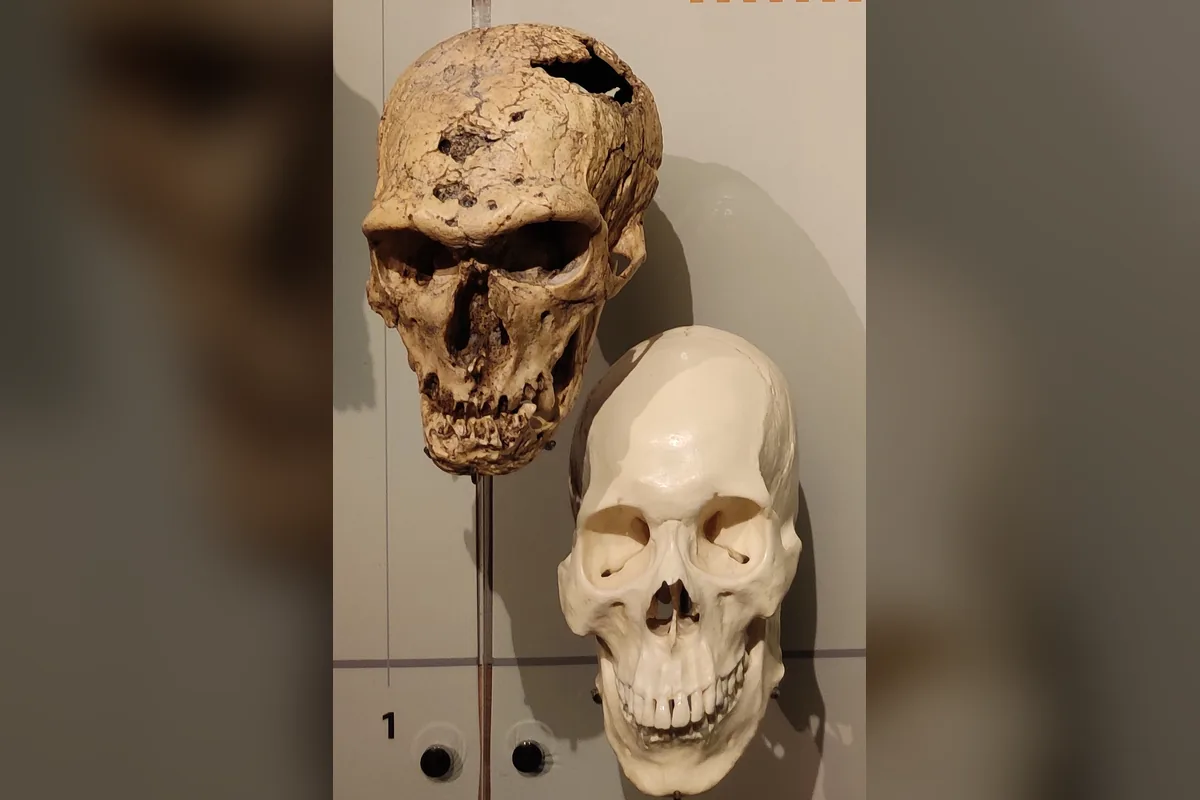
Run your finger along the front of your lower jaw. The forward-pointing bump at the bottom is your chin, and anatomists can use it to tell a modern human jaw from any other primate's at a glance. Chimpanzees and gorillas lack one. So did Neanderthals, Homo erectus and every other extinct human species.
The question of why humans have chins has been argued for more than 150 years. In a 2016 review titled "The enduring puzzle of the human chin", James Pampush and David Daegling concluded that none of the popular explanations was well supported. Since then, the evidence has tilted towards an unglamorous answer.
What a chin actually is
Anatomists call the chin the mental eminence, from the Latin mentum, meaning chin. A true chin has two parts:
- A raised, triangular area of bone at the front of the jaw, the mental trigone, often described as an upside-down "T".
- A forward projection at the base of the jaw that sticks out further than the bone around the lower front teeth.
Other hominins had strong jaws, but the front surface sloped backwards below the teeth. Some Neanderthal jaws have a slight bump, and researchers debate whether that counts as an early chin. Most agree that only Homo sapiens shows the full combination.
The chin also develops in a distinctive way. Newborns have only a faint one. It becomes more prominent through childhood and adolescence, and in 2015 Nathan Holton and colleagues showed that this growth pattern does not track the mechanical loads from chewing.
When did the chin appear?
Our species appears in Africa about 300,000 years ago (see Jebel Irhoud vs Omo Kibish). Clear chins are present in early modern humans from sites such as Skhul and Qafzeh in Israel, roughly 90,000–120,000 years ago. The details of when the chin first appeared are blurred by the small number of complete early jaws.
What is clear is that the chin arrived along with other features of the modern face: a smaller face set under the braincase, a reduced brow ridge, and smaller teeth. That timing is a strong clue.
Theory 1: a buttress for chewing
The oldest idea is that the chin strengthens the jaw against stress from chewing, especially the bending and twisting forces at the front of the jaw. It sounds logical, since the chin sits where the two halves of the jaw meet.
The evidence is weak. Modern humans have smaller teeth, smaller jaw muscles and softer, often cooked diets than their ancestors. Holton's growth study found that the chin does not grow in step with chewing forces. If anything, we need less reinforcement than our ancestors did, not more. The chewing explanation has largely fallen out of favour.
Theory 2: speech
A second idea links the chin to speech. Rapid tongue and lip movements might stress the front of the jaw, and the chin could resist those forces. Some modelling studies, including work by Ionut Ichim and colleagues in the mid-2000s, have explored this.
Critics point out that the forces from speaking are small compared with chewing, and that Neanderthals probably spoke without chins. The speech link remains possible but unconvincing to most researchers.
Theory 3: sexual selection
Chin shape differs between men and women. In 2010, Zaneta Thayer and Seth Dobson measured chin shape across populations and found that men tend to have taller, more square chins and women more rounded, pointed ones.
That pattern fits the idea that, once chins existed, mate choice could have exaggerated them as signals of sex or maturity. It does not explain why chins appeared in the first place, and Thayer and Dobson were cautious about strong conclusions. Most researchers see sexual selection as a possible later influence, not the origin.
Why do humans have chins? The spandrel answer
The leading view is that the chin is a by-product. The term "spandrel" comes from a 1979 paper by Stephen Jay Gould and Richard Lewontin. In architecture, spandrels are the triangular spaces created where arches meet. Nobody designs them for their own sake. They appear because of the arches.
In January 2026, Noreen von Cramon-Taubadel and colleagues tested this idea in PLOS One. They measured skull and jaw traits across apes and humans and estimated the rate of change along each branch of the family tree. They found strong directional selection in the human lineage on traits such as a flexed skull base, an expanded braincase, a less projecting lower face and a lighter, more parabolic jaw.
Of nine traits tied to the chin itself, only three showed direct selection. The other six showed no selection or only indirect selection. The authors concluded that the chin evolved largely as a side effect of selection for smaller front teeth and the facial changes linked to upright posture and skull shape.
In simple terms: as our faces and teeth shrank and tucked back under the braincase, the bone around the tooth roots reduced more than the base of the jaw. The base was left sticking out. That leftover is the chin.
| Explanation | Core idea | Current support |
|---|---|---|
| Chewing | Reinforces the jaw against bite forces | Weak |
| Speech | Resists forces from tongue and lip muscles | Weak |
| Sexual selection | Shape signals sex or maturity | Possible later influence |
| Facial reduction (spandrel) | Leftover bone as the face and teeth shrank | Strongest, supported by 2026 analysis |
A link to tamer faces?
Some researchers connect facial reduction to social behaviour. In 2014, Robert Cieri and colleagues argued that brow ridges and faces became less robust in modern humans over the last 200,000 years. They linked this to lower testosterone and greater social tolerance, a kind of "self-domestication". If correct, the chin could be an indirect trace of how human societies changed. The idea is interesting but hard to test, and it remains speculative.
Why it matters
The chin is a reminder that not every trait is an adaptation with a neat purpose. Some features are side effects of other changes, here the smaller, flatter face that also gave us a high forehead and small brow. It also makes a useful field marker: find a fossil jaw with a true chin and you are almost certainly looking at our own species. Explore how the face changed over time on the interactive family tree, or read what makes us human.
The chin is just one of the traits that set our species apart. See the whole family tree.
Explore the family tree →Frequently asked questions
Why do humans have chins?
The leading explanation is that the chin is a by-product of our faces and front teeth getting smaller and tucking under the braincase. A 2026 analysis found direct selection on only three of nine chin-related traits. Chewing and speech explanations have weak support.
Did Neanderthals have chins?
No. Neanderthals had strong jaws but no true bony chin. A few Neanderthal jaws have a slight bump at the front, but the full chin is unique to Homo sapiens.
Are humans the only animal with a chin?
Yes. No other living primate, and no other human species, has a true bony chin. It is one of the most reliable features for identifying a modern human jaw.
What does it mean that the chin is a spandrel?
It means the chin was not selected for its own function. It formed as a side effect of selection on other parts of the skull and jaw, much as the triangular spaces between arches appear automatically when arches are built.
- Pampush, J. D. & Daegling, D. J. (2016). 'The enduring puzzle of the human chin.' Evolutionary Anthropology 25: 20–35. doi.org
- Holton, N. E. et al. (2015). 'The ontogeny of the chin: an analysis of allometric and biomechanical scaling.' Journal of Anatomy 226: 549–559. doi.org
- Thayer, Z. M. & Dobson, S. D. (2010). 'Sexual dimorphism in chin shape: implications for adaptive hypotheses.' American Journal of Physical Anthropology 143: 417–425. doi.org
- von Cramon-Taubadel, N. et al. (2026). 'Is the human chin a spandrel? Insights from an evolutionary analysis of ape craniomandibular form.' PLOS One 21: e0340278. doi.org