Ardipithecus (~5.8–4.4 million years ago, famous for 'Ardi') was an early hominin that walked upright on the ground but kept a grasping big toe for climbing, with small canines and an ape-sized brain. Australopithecus (~4.2–2 million years ago, famous for 'Lucy') was a committed biped that lost the grasping toe and gained a more human-like foot and pelvis. The shift between them tracks the commitment to life on two legs.
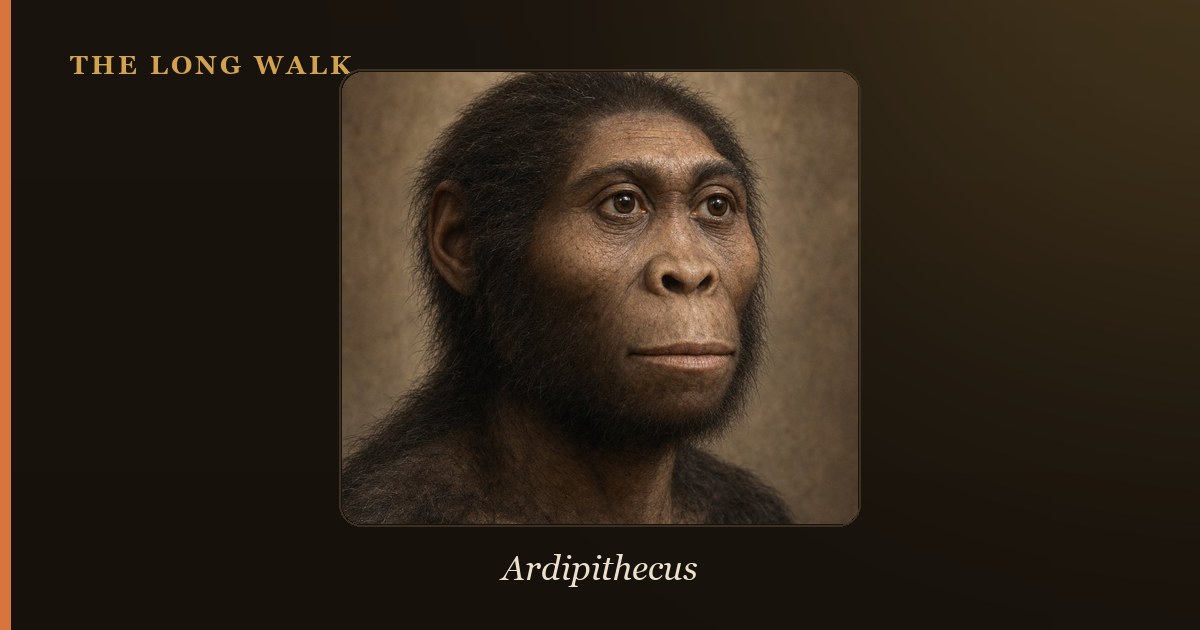
In 2009, the description of Ardi — a 4.4-million-year-old skeleton of Ardipithecus ramidus — rewrote the textbooks. Here was a creature that walked upright when on the ground, yet still had an ape-like grasping big toe for moving through the trees. Half a million years later, Lucy and her species Australopithecus afarensis had a foot built solely for walking.
The Ardipithecus vs Australopithecus comparison captures that pivotal window — roughly 4.4 to 3.9 million years ago — when our ancestors committed fully to the ground. It also overturned the old idea that our last common ancestor with chimps looked like a chimp.
| Ardipithecus and Australopithecus compared | Ardipithecus | Australopithecus |
|---|---|---|
| Lived | ~5.8–4.4 million years ago | ~4.2–2.0 million years ago |
| Brain size | ~300–350 cc (ape-sized) | ~380–560 cc |
| Big toe | Grasping, divergent (climbing) | Aligned, non-grasping (walking) |
| Locomotion | Upright on ground + tree climbing | Committed bipedalism |
| Habitat | Woodland | Woodland to open grassland |
| Famous fossil | Ardi (ARA-VP-6/500) | Lucy (AL 288-1) |
| Key site | Aramis, Middle Awash, Ethiopia | Hadar, Laetoli, Sterkfontein |
| Relationship | Early hominin, near/on line to Australopithecus | Likely ancestor of Homo & Paranthropus |
Who was Ardipithecus?
Ardipithecus includes two species — the older Ar. kadabba (~5.8–5.2 Ma) and the famous Ar. ramidus (~4.4 Ma). The latter is known from Ardi, one of the most complete early-hominin skeletons ever found, recovered over years of painstaking work in the Middle Awash of Ethiopia and described in 2009.
Ardi reveals a true mosaic. Her pelvis was modified for upright walking on the ground, but her foot kept a divergent, grasping big toe for climbing, and her hands and limbs suggest careful movement along branches rather than knuckle-walking. Her brain was ape-sized (~300–350 cc), and her canine teeth were small and similar between the sexes — a hint of reduced male competition. Crucially, Ardi suggests the human–chimp ancestor was not chimp-like. See the Ardipithecus page.
Who was Australopithecus?
Australopithecus ("southern ape") flourished from about 4.2 to 2 million years ago and is the genus that bridges Ardi's world and our own. Its best-known member, A. afarensis, is represented by Lucy and the Laetoli footprints. Compared with Ardi, australopiths were committed bipeds: the grasping toe is gone, the foot has a human-like arch, and the pelvis and legs are fully reorganised for walking — though long arms and curved fingers show they still climbed. Their brains were modestly larger. More on the Australopithecus afarensis page.
The key differences
The foot — the headline
Nothing separates the two more clearly than the big toe. Ardi's diverges outward like a thumb, perfect for gripping branches. The australopith toe lies in line with the others, sacrificing climbing for an efficient walking stride. That single change marks a deepening commitment to terrestrial life.
Locomotion and habitat
Ardipithecus combined ground bipedalism with significant tree-climbing in a woodland setting. Australopithecus leaned harder into walking and ranged into more open environments — though both kept one foot, almost literally, in the trees.
Brain and teeth
Brain size rose only modestly between the two — this stretch of evolution was about locomotion and ecology, not intelligence. Both had small canines compared with apes, part of a long-term trend in the hominin face.
Did they ever meet?
Probably not as contemporaries. Ardipithecus ramidus at 4.4 Ma sits just before the earliest Australopithecus (A. anamensis at ~4.2 Ma, then afarensis). The relationship is widely read as ancestor-to-descendant or very close to it — Ardipithecus on or near the line that produced Australopithecus — rather than two species sharing the landscape.
Why it matters
This comparison shows that upright walking did not arrive in one leap. It was assembled in stages, and for a long time our ancestors did both — walking the ground and climbing the trees. Ardi also delivered a deeper lesson: we cannot read our origins backward from living chimpanzees, because the common ancestor was its own creature. The road to bipedalism was longer, stranger, and more wooded than the old "ape stands up on the savanna" story allowed.
Trace the earliest steps of upright walking — from Ardipithecus to the australopiths — on the interactive deep-time tree.
Explore the family tree →Frequently asked questions
Who was Ardipithecus?
An early hominin genus from Ethiopia with two species: Ar. kadabba, about 5.8 to 5.2 million years old, and Ar. ramidus, about 4.4 million years old. Ar. ramidus is best known from the partial skeleton Ardi, published in 2009.
Who was Australopithecus?
A genus of upright-walking, small-brained hominins that lived in Africa from roughly 4.2 to 2 million years ago. Its most famous species, A. afarensis, includes the Lucy skeleton and the makers of the Laetoli trackways.
Did they ever meet?
Probably not. Ar. ramidus dates to about 4.4 million years ago, just before the first Australopithecus, A. anamensis, at about 4.2 million. Most researchers see Ardipithecus as an ancestor of Australopithecus or a close relative of that ancestor.
- White, T. D. et al. (2009). "Ardipithecus ramidus and the paleobiology of early hominids." Science 326. science.org
- Lovejoy, C. O. (2009). "Reexamining human origins in light of Ardipithecus ramidus." Science 326. science.org
- Smithsonian Human Origins — Ardipithecus ramidus. humanorigins.si.edu