Scientists reconstruct what extinct humans ate by combining several methods. Stable isotopes in bone and enamel show the type of plants eaten and how much meat. Microwear on teeth records the texture of the last meals. Dental calculus traps food particles and DNA. Cut marks, charred food and fossil faeces add direct evidence. No single method is complete, and each has corrected the others.
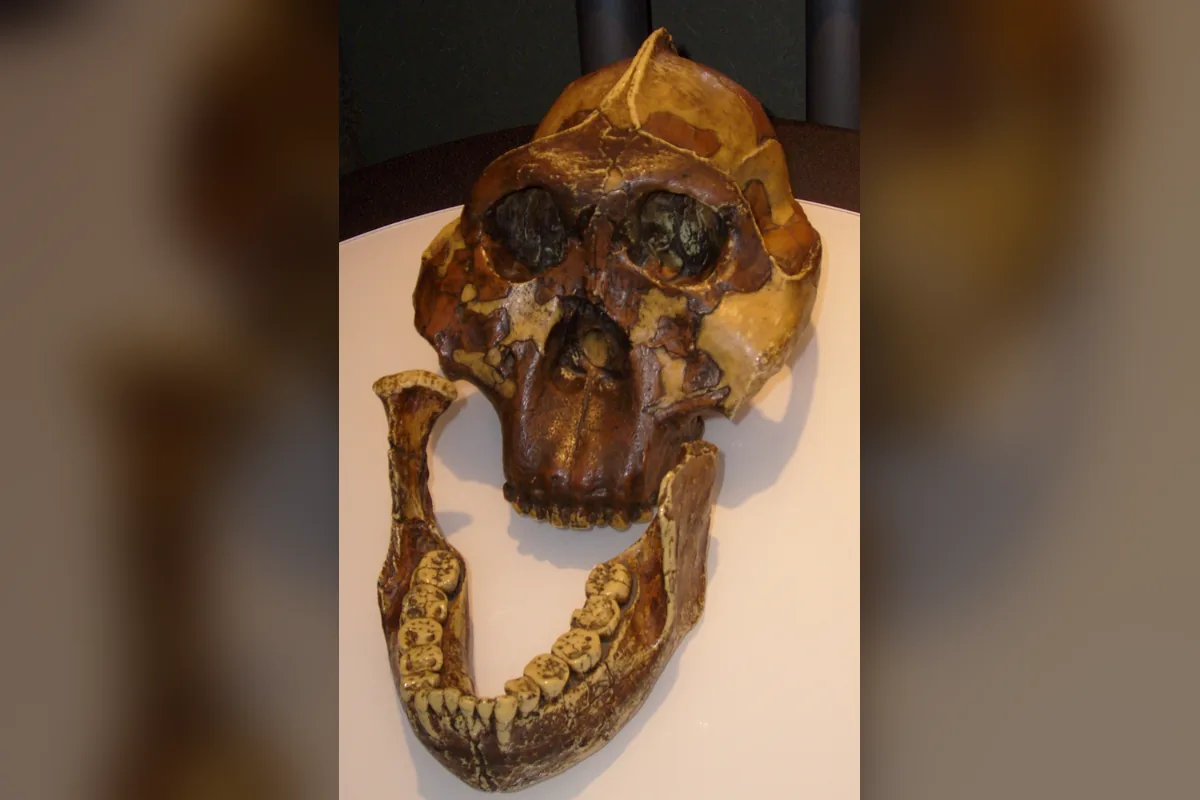
When Mary Leakey found the skull known as OH 5 at Olduvai Gorge in 1959, its molars were the largest of any hominin then known, with thick enamel and a massive jaw. It was nicknamed "Nutcracker Man", and for decades Paranthropus boisei was pictured cracking hard nuts and seeds.
Then the teeth were tested. Microscopic wear showed few of the pits that hard foods leave. In 2011, Thure Cerling and colleagues measured carbon isotopes in P. boisei enamel and found that about three-quarters of its diet came from grasses or sedges. Nutcracker Man ate more like a grazing animal than a nut-cracker.
That reversal shows why the question of what extinct humans ate cannot be answered from anatomy alone. Here are the main methods, what each reveals, and their limits.
| Method | What it reveals | Time span covered |
|---|---|---|
| Carbon isotopes | Tree and shrub foods versus tropical grasses and sedges | Years (enamel forms in childhood) |
| Nitrogen isotopes | Position in the food chain; how much animal protein | Last decade or so of life (bone collagen) |
| Zinc isotopes | Meat-eating, in fossils too old for collagen | Childhood (enamel) |
| Dental microwear | Hard versus tough food textures | Last days to weeks |
| Dental calculus | Starch grains, plant silica, DNA, proteins | Years of build-up |
| Cut marks and charred food | Which animals and plants were processed | Single events |
| Coprolites and faecal biomarkers | Meat-to-plant balance in actual meals | Single meals |
Isotopes: you are what you eat
Atoms of the same element come in slightly different weights, called isotopes. The ratios of these isotopes change in predictable ways through food chains, and they are locked into bone and tooth enamel.
Carbon: which plants?
Trees, shrubs and most temperate plants use one photosynthetic pathway, called C3. Tropical grasses and sedges mostly use another, called C4, which leaves more of the heavier carbon-13 isotope. Animals that eat these plants, or eat animals that ate them, inherit the signal.
Early hominins such as Ardipithecus had diets dominated by C3 foods, like chimpanzees. From about 3.5 million years ago, some hominins began adding C4 foods. P. boisei took this furthest. Australopithecus sediba, by contrast, ate an almost entirely C3 diet, and in 2012 Amanda Henry and colleagues found tree bark fragments in its dental calculus.
Nitrogen: how much meat?
Nitrogen-15 increases by a few parts per thousand at each step up a food chain. A carnivore's bone collagen has more of it than a herbivore's. In 2009, Michael Richards and Erik Trinkaus showed that European Neanderthals had nitrogen values similar to wolves and hyenas, so most of their protein came from large animals. Early modern humans had a wider range, including freshwater fish.
Collagen rarely survives more than about 100,000 years, so nitrogen isotopes only work for later fossils. A newer method uses zinc isotopes in enamel, which survive much longer. Zinc analysis of a Neanderthal tooth from Gabasa in Spain, published in 2022, also pointed to a highly carnivorous diet.
Microwear: the last meals
Under a microscope, tooth surfaces carry tiny scratches and pits. Hard, brittle foods such as nuts and seeds leave pits. Tough foods such as leaves and meat leave long, parallel scratches. Peter Ungar and others now measure these surfaces in 3D to compare species.
Microwear is quickly worn away and replaced, so it captures only the last days or weeks before death. This is called the "last supper" effect. It is excellent for showing what a species could eat in a particular season, but it can miss foods eaten at other times of year.
Dental calculus: a time capsule in tartar
Dental calculus is plaque that hardened on the teeth during life. As it builds up, it traps starch grains, plant silica bodies (phytoliths), pollen, bacteria and even DNA and proteins from food.
In 2011, Amanda Henry, Alison Brooks and Dolores Piperno found starch grains in calculus from Neanderthals at Shanidar Cave in Iraq and Spy Cave in Belgium. Some grains showed damage from cooking. The plants included grasses related to wild barley, legumes and date palms. That overturned the idea of Neanderthals as pure meat-eaters.
In 2012, Karen Hardy and colleagues detected chemical traces of yarrow and chamomile in calculus from El Sidrón, Spain. Both are bitter and have little food value, which led to the suggestion that Neanderthals used them as medicine. In 2017, Laura Weyrich and colleagues sequenced DNA from calculus. Neanderthals from Spy showed traces of woolly rhinoceros and wild sheep, while those from El Sidrón showed mushrooms, pine nuts and moss, with no clear meat. Calculus DNA is prone to contamination, and some of these identifications have been questioned, so treat specific species with caution.
Cut marks, charred food and fossil faeces
Stone-tool cut marks on animal bones show which animals were butchered. Some of the earliest accepted examples come from Gona in Ethiopia and Kanjera South in Kenya, roughly 2.6 to 2 million years ago. Older claims, such as marks on 3.39-million-year-old bones from Dikika in Ethiopia, are disputed.
Charred food sometimes survives. In 2023, Ceren Kabukcu and colleagues analysed burnt plant remains from Shanidar Cave and Franchthi Cave in Greece. They found that Neanderthals and early modern humans pounded and cooked pulses and other seeds, with evidence of soaking and mixing ingredients. Our article on the control of fire covers when cooking began.
Fossil faeces are rare but direct. At El Salt in Spain, about 50,000 years ago, Ainara Sistiaga and colleagues identified chemical markers from Neanderthal faeces in 2014. The markers showed mostly meat, with a clear plant component.
What extinct humans ate: limits and surprises
Every method has blind spots:
- Isotopes average years of diet and mostly track protein, so plant foods can be underestimated.
- Microwear shows only the final days.
- Calculus preserves some foods, such as starchy plants, better than others.
- Cut marks show butchery, not how much meat was eaten.
Used together, they agree on a general picture. Most hominins were flexible, and diets varied by place and season. The old images of the meat-only caveman and the specialised nut-cracker have both been replaced by more varied menus.
Why it matters
Diet shaped human evolution. A richer diet with more meat and, later, cooked food is closely tied to larger brains and smaller guts (see why human brains are so big). Knowing what our relatives ate, and how flexibly, is central to understanding what made us human. For specific examples, see what Neanderthals hunted, or explore each species on the interactive family tree.
Curious how we date all these finds? See the methods behind every date on this site.
Read how fossils are dated →Frequently asked questions
How do scientists know what early humans ate?
By combining isotopes in bone and enamel, microscopic tooth wear, food particles and DNA trapped in dental calculus, cut marks on animal bones, charred food remains and, rarely, fossil faeces. Each method captures a different part of the diet.
Were Neanderthals pure carnivores?
No. Nitrogen and zinc isotopes show that most of their protein came from large animals, but dental calculus and charred remains show they also ate cooked grasses, legumes, seeds and other plants.
What is dental calculus?
Dental calculus is plaque that hardened on the teeth during life. It traps starch grains, plant silica, microbes, DNA and proteins, making it a long-term record of diet and health.
What did Nutcracker Man really eat?
Despite its huge molars, Paranthropus boisei ate mostly grasses or sedges, according to carbon isotopes in its enamel. Tooth wear shows few signs of hard nuts or seeds.
- Cerling, T. E. et al. (2011). 'Diet of Paranthropus boisei in the early Pleistocene of East Africa.' PNAS 108: 9337–9341. doi.org
- Richards, M. P. & Trinkaus, E. (2009). 'Isotopic evidence for the diets of European Neanderthals and early modern humans.' PNAS 106: 16034–16039. doi.org
- Henry, A. G., Brooks, A. S. & Piperno, D. R. (2011). 'Microfossils in calculus demonstrate consumption of plants and cooked foods in Neanderthal diets (Shanidar III, Iraq; Spy I and II, Belgium).' PNAS 108: 486–491. doi.org
- Weyrich, L. S. et al. (2017). 'Neanderthal behaviour, diet, and disease inferred from ancient DNA in dental calculus.' Nature 544: 357–361. doi.org