"Cro-Magnon" is the old name for the earliest Homo sapiens in Europe (~45,000–10,000 years ago) — anatomically modern humans, not a separate species. They differed from the resident Neanderthals in being taller and lighter-built, and in their rich Upper Palaeolithic culture: blade tools, bone and ivory work, ornaments, and cave art. They overlapped with, interbred with, and ultimately replaced the Neanderthals.
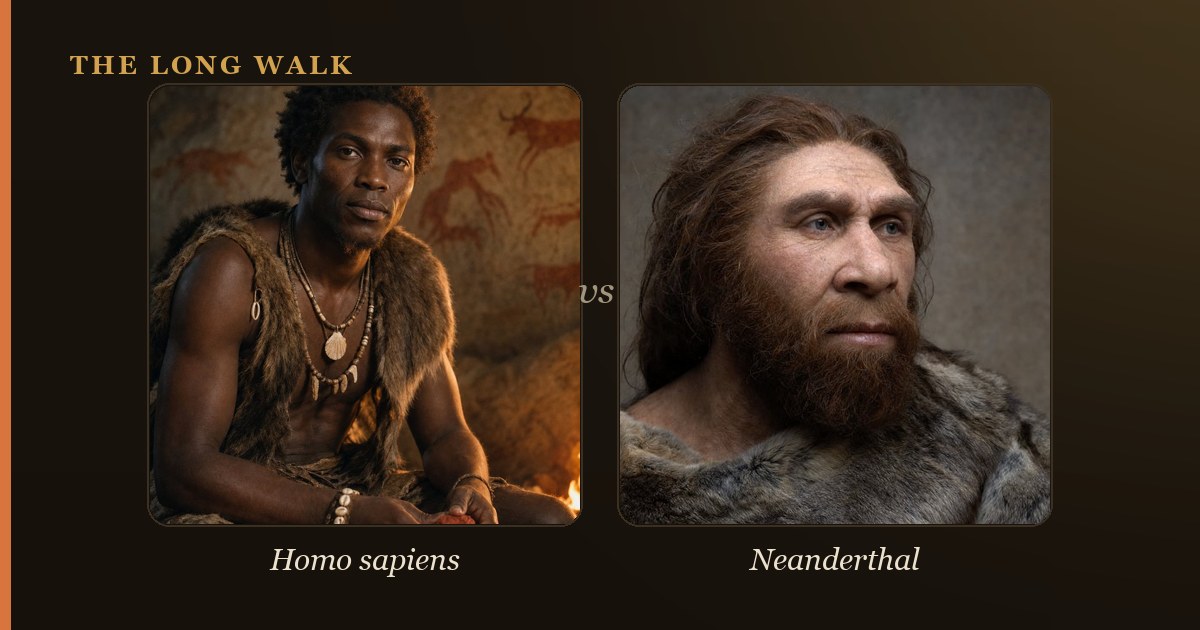
In 1868, workers in the Cro-Magnon rock shelter in southwest France uncovered the skeletons of tall, modern-looking people buried with pierced shells. They became the namesake of the Cro-Magnons — the first modern humans of Ice Age Europe. The crucial thing to know up front: Cro-Magnons were Homo sapiens, the same species as us, not a separate kind of human.
So the real Cro-Magnon vs Neanderthal comparison is between the modern humans who swept into Europe around 45,000 years ago and the Neanderthals who had lived there for hundreds of millennia before them. One culture replaced the other — and we are still piecing together how.
| Cro-Magnons and Neanderthals compared | Cro-Magnon (early modern humans) | Neanderthals |
|---|---|---|
| Who | Early Homo sapiens in Europe | Homo neanderthalensis |
| In Europe | ~45,000–10,000 years ago | ~430,000–40,000 years ago |
| Build | Tall (~1.7–1.8 m), slender | Shorter, stocky, cold-adapted |
| Skull | High forehead, chin, small brow | Long skull, big brow, no chin |
| Tools | Aurignacian/Gravettian/Magdalenian blades | Mousterian flake tools |
| Culture | Cave art, ivory figurines, bone needles | Pigments, ornaments, burials |
| Famous for | Chauvet, Lascaux, Venus figurines | Surviving Ice Age Europe |
| Outcome | Spread across Europe; ancestors of Europeans | Disappeared ~40,000 years ago |
Who were the Cro-Magnons?
"Cro-Magnon" is really a nickname for the European populations of early Homo sapiens during the Upper Palaeolithic. Anatomically they are fully modern: tall and long-limbed, with a high vaulted forehead, a small face, only a faint brow, and a distinct chin. Many anthropologists now avoid the term as a formal label, preferring "early modern humans" or "anatomically modern humans" — but it endures because the Cro-Magnons left such a spectacular cultural record.
That record is the Upper Palaeolithic in full bloom: finely worked blade tools, the first widespread bone, antler, and ivory technology, eyed needles for tailored clothing, long-distance trade in shells and flint, personal ornaments, musical instruments, and the breathtaking painted caves of Chauvet and Lascaux. These were the same people, biologically, as the readers of this page — see the Homo sapiens page.
Who were the Neanderthals?
The Neanderthals were the long-established Europeans, present for well over 300,000 years before modern humans arrived. Stocky and cold-adapted, with a large brain in a long skull, they were expert hunters who made Mousterian tools, buried their dead, and used pigments and ornaments. When the Cro-Magnons walked into Europe, they were not entering an empty continent — they were entering Neanderthal country. More on the Neanderthal page.
The key differences
Body and face
Cro-Magnons were taller, leaner, and lighter-boned — a tropical body plan recently arrived from Africa — versus the compact, heavily muscled, cold-adapted Neanderthal frame. The faces differ sharply too: a flat modern face with a jutting chin versus a forward-projecting Neanderthal midface beneath a heavy brow.
Technology and culture
This is the most visible gulf. The Cro-Magnon Aurignacian and later cultures are defined by standardised blades, abundant bone and ivory tools, and an explosion of art and ornament. Neanderthal Mousterian technology was effective and intelligent but more conservative, with far less in the way of figurative art and worked bone. (For the toolkits themselves, see Mousterian vs Aurignacian.)
Networks
Cro-Magnon sites show raw materials and ornaments transported over hundreds of kilometres, hinting at wide social networks. These larger, better-connected populations could share innovations and weather hard times — a likely edge over smaller, more isolated Neanderthal bands.
Did they ever meet?
Yes. For several thousand years — roughly 45,000 to 40,000 years ago — Cro-Magnons and Neanderthals shared the European landscape. They interbred: living Europeans, like other non-Africans, carry about 2% Neanderthal DNA, and some of the earliest modern Europeans had recent Neanderthal ancestors. The transitional Châtelperronian industry may even record Neanderthals adopting or imitating new techniques as the two populations overlapped.
Why it matters
The Cro-Magnons are the clearest evidence that the people of the deep Ice Age were fully us — that the capacity for art, symbolism, and complex culture arrived with Homo sapiens rather than developing slowly afterward. Their replacement of the Neanderthals, with interbreeding along the way, is the closest the human story comes to documenting one kind of human giving way to another. Their painted caves are, in a real sense, the oldest surviving chapter of the human imagination.
The Cro-Magnons are simply the European face of Homo sapiens. See where our species sits — and how it overlapped with the Neanderthals — on the interactive family tree.
Explore the family tree →Frequently asked questions
Who were the Cro-Magnons?
"Cro-Magnon" is really a nickname for the European populations of early Homo sapiens during the Upper Palaeolithic. Anatomically they are fully modern: tall and long-limbed, with a high vaulted forehead, a small face, only a faint brow, and a distinct chin.
Who were the Neanderthals?
The Neanderthals were the long-established Europeans, present for well over 300,000 years before modern humans arrived. Stocky and cold-adapted, with a large brain in a long skull, they were expert hunters who made Mousterian tools, buried their dead, and used pigments and ornaments.
Did they ever meet?
Yes. For several thousand years — roughly 45,000 to 40,000 years ago — Cro-Magnons and Neanderthals shared the European landscape. They interbred: living Europeans, like other non-Africans, carry about 2% Neanderthal DNA, and some of the earliest modern Europeans had recent Neanderthal ancestors.
- Fu, Q. et al. (2016). "The genetic history of Ice Age Europe." Nature 534. nature.com
- Benazzi, S. et al. (2011). "Early dispersal of modern humans in Europe and implications for Neanderthal behaviour." Nature 479. nature.com
- Hublin, J.-J. (2015). "The modern human colonization of western Eurasia." Quaternary Science Reviews. sciencedirect.com
- Smithsonian Human Origins — Homo sapiens. humanorigins.si.edu