In the debate of archaic vs anatomically modern Homo sapiens, "archaic" is a loose label for early, transitional members of our own species — people who mix primitive traits (a long, low skull and heavy brow) with budding modern ones. "Anatomically modern" means the full modern skeletal package: a globular braincase, a small face tucked under the brain, and a true bony chin.
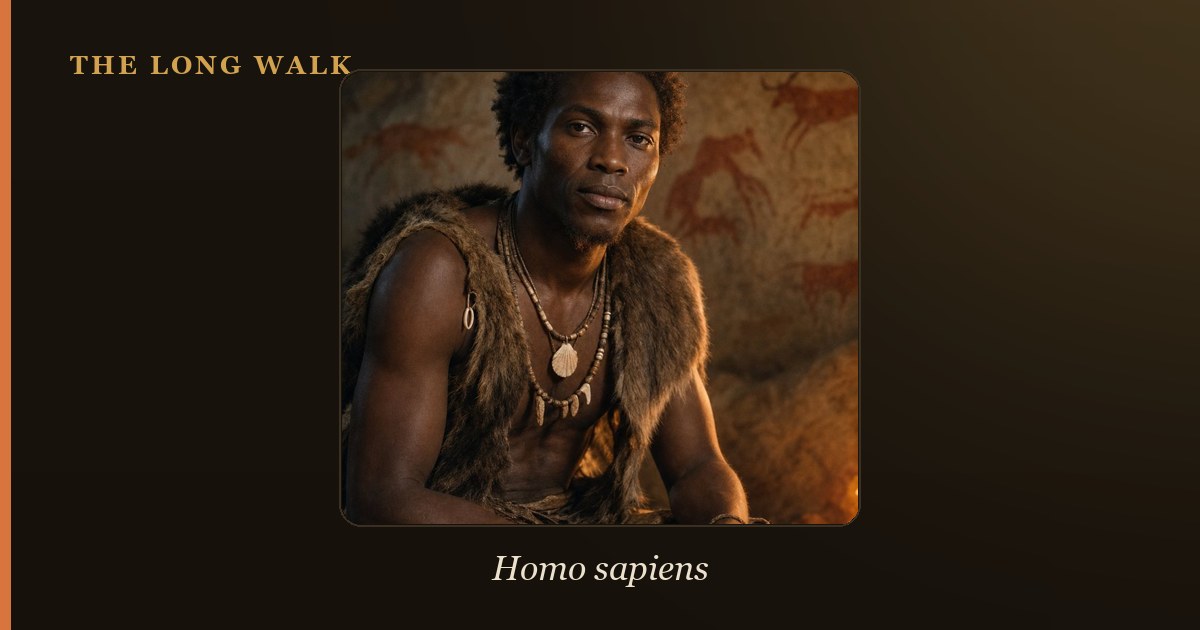
In 2017, fossils from Jebel Irhoud in Morocco were redated to about 315,000 years ago — pushing the origin of our species back by roughly 100,000 years in a single paper. What made the find so unsettling was not just its age. The faces looked almost like ours, but the braincases were long and low, nothing like the rounded skull you carry today. That single mismatch is exactly what the comparison of archaic vs anatomically modern Homo sapiens is about.
"Modern" turns out to be a checklist of skeletal features, not a date on a calendar. Our species did not switch from archaic to modern overnight; different parts of the skeleton crossed the line at different times. To understand the difference is to understand that becoming human was a gradual, patchwork process — and that the word "archaic" is doing a lot of quiet, contested work. Here is what the bones actually say.
| Archaic vs modern, at a glance | Archaic Homo sapiens | Anatomically modern humans |
|---|---|---|
| Time period | ~300,000–100,000 years ago | Emerging by ~200,000; widespread by ~100,000–40,000 |
| Braincase shape | Long, low, elongated (non-globular) | Globular, high, rounded vault |
| Brow / face | Heavier brow; larger, more projecting face | Reduced brow; small face retracted under the skull |
| Chin | Weak or absent bony chin | True chin (mental eminence) |
| Key fossils | Jebel Irhoud, Florisbad, Omo I, Herto | Later Omo, Herto, Qafzeh/Skhul, Cro-Magnon |
| "Modern" status | A mosaic — some modern traits, some primitive | The full modern skeletal package |
What "archaic Homo sapiens" means
"Archaic Homo sapiens" is not a tidy, agreed-upon species. It is a loose, somewhat contested label that researchers use for early or transitional members of our own lineage, roughly 300,000 to 100,000 years ago, that are clearly on the way to being us but are not fully there yet. These are people you would recognise as close kin, not strangers — but their skulls keep one foot in the past.
The defining feature of an archaic skull is a mosaic: modern traits sitting alongside primitive ones in the same head. The braincase is typically long and low rather than rounded. The brow ridge is heavier than ours. The face is larger and projects further forward. Yet other features — a smaller dentition, a thinning of the bone, a hint of a steeper forehead — already lean modern.
Because the label is so fuzzy, many researchers prefer to avoid "archaic Homo sapiens" altogether, talking instead about "early Homo sapiens" or naming individual populations. The term has also historically been a dumping ground for fossils that did not fit neatly into Homo erectus or fully modern humans. Treat it as a useful shorthand, not a hard biological category. For the full account of our species, see the Homo sapiens species page.
What "anatomically modern" means
"Anatomically modern" is far more concrete. It refers to a specific bundle of skeletal traits — the same package that distinguishes your skeleton from that of any earlier human. A fossil counts as anatomically modern when it carries the whole set, not just one or two pieces of it.
The core features are:
- A globular braincase — a high, rounded skull vault, tallest above the ears, rather than a long, low loaf.
- A small, retracted face tucked beneath the front of the brain instead of jutting out ahead of it.
- A reduced brow ridge, often broken into separate arches rather than a continuous bony bar.
- A true bony chin, the mental eminence — a forward projection of the lower jaw that no other hominin reliably shows.
- An overall gracile skeleton: thinner bone walls and lighter, less heavily muscled limbs than archaic or Neanderthal builds.
The chin deserves special attention because it is the single most reliable modern signature. The mental eminence is the bony bump at the front of your jaw, and it appears in Homo sapiens and essentially nowhere else. When a paleoanthropologist wants a quick test for "modern," the chin is often the first thing they look for.
Key differences
Globular vs elongated braincase
This is the headline difference. Archaic skulls are elongated front-to-back and low-vaulted, the classic "long low" shape inherited from earlier Homo. Modern skulls are globular — they bulge outward and upward, especially in the parietal and cerebellar regions. The change is not really about brain size; archaic and modern brains overlap heavily in volume. It is about brain shape, and the rounding is thought to reflect reorganisation of the parietal lobes and cerebellum.
The retracted face
In archaic skulls the face sits in front of the braincase and projects forward. In modern humans the face has retracted, pulling back and downward so that it tucks under the front of the brain. This is why our profile looks flat and "tucked in" compared with the muzzle-forward look of older humans. Jebel Irhoud is the famous exception that proves the rule: its face was already remarkably modern while its braincase was not.
The chin and brow
The brow ridge shrinks and the chin appears. Archaic faces carry a thick, shelf-like supraorbital torus; modern faces reduce it to a modest, often divided ridge. Meanwhile the lower jaw develops its mental eminence. These two changes — losing the brow shelf, gaining the chin — neatly bracket the modern face.
Gracility
Modern skeletons are lighter throughout. Bone walls are thinner, limb shafts are slimmer, and muscle markings are less pronounced than in robust archaic or Neanderthal bodies. This gracility extends from the skull to the post-cranial skeleton and is one reason modern remains can look almost delicate beside their predecessors.
The transition was a mosaic
The single most important idea here is that these features did not arrive together. Different fossils show different combinations, which is exactly why "archaic" and "modern" blur into each other.
Jebel Irhoud, Morocco (~315,000 years). Redated by Hublin and colleagues in 2017, these are among the earliest fossils attributed to Homo sapiens. The face and jaw are essentially modern, but the braincase is elongated and low — the textbook mosaic. They tell us the modern face evolved before the modern skull shape.
Florisbad, South Africa (~260,000 years). A partial cranium with a mix of robust and modern features, often discussed as early or "archaic" Homo sapiens and showing that the transitional pattern was a continent-wide African phenomenon, not a local fluke.
Omo Kibish, Ethiopia (Omo I, ~233,000 years). Long dated to about 195,000 years by McDougall and colleagues in 2005, Omo I was redated to at least 233,000 years by Vidal and colleagues in 2022. It is among the earliest fossils with a largely modern skull, including a more rounded vault — a major step toward the full package.
Herto, Ethiopia (~160,000 years). Described by Tim White's team in 2003 as Homo sapiens idaltu, the Herto crania are nearly modern but retain a few robust touches, which is why they were given their own subspecies name. They sit right at the threshold of "anatomically modern."
One fossil deserves a careful note. Broken Hill (Kabwe), Zambia was once filed under "archaic Homo sapiens," but most researchers now assign it to Homo heidelbergensis (or the proposed species Homo bodoensis) rather than to our species at all. It is a reminder of how unstable the "archaic" label has been. By around 100,000 to 40,000 years ago, fully modern morphology — seen at sites such as Qafzeh and Skhul in the Levant and later Cro-Magnon in Europe — was widespread.
Anatomically modern vs behaviourally modern
Here is a distinction that trips up almost everyone: anatomically modern and behaviourally modern are not the same thing.
Anatomically modern is about the skeleton — the globular skull, the small face, the chin. Behaviourally modern is about what people did: symbolic thought, complex multi-stage tools, personal ornaments, pigment use, art, and long-distance exchange. The two do not switch on at the same moment.
People with essentially modern skeletons existed well before the archaeological record fills with unambiguous symbolic behaviour. The signs of modern behaviour appear patchily across Africa over a long stretch of the Middle Stone Age and only become consistent later. So you can have an anatomically modern human who is not yet leaving behind the rich symbolic toolkit we associate with full behavioural modernity — and that gap is one of the most active questions in the field.
Why it matters
The archaic-to-modern story rewrites the popular image of human origins. There was no single moment when we became modern, no finish line crossed in one stride. Instead, our species assembled itself trait by trait, across the whole African continent, over hundreds of thousands of years. Jebel Irhoud's modern face on an old-shaped skull is the perfect emblem of that patchwork.
It also teaches humility about labels. "Archaic Homo sapiens" is a convenient bin, not a sharp species, and fossils have moved in and out of it as the science improves. What stays solid is the checklist of anatomically modern traits — and the recognition that the people who first wore that full skeleton were our direct kin, even if their minds and toolkits took longer to catch up. Trace exactly where these fossils fall in deep time on the interactive evolution timeline.
See where archaic and anatomically modern Homo sapiens sit in the sweep of human evolution — every fossil, dated and placed, on the interactive deep-time tree.
Explore the family tree →Frequently asked questions
What is the difference between Archaic and Anatomically Modern Homo sapiens?
Both belong to our species. Archaic Homo sapiens, such as the Jebel Irhoud people, pair a long, low braincase and heavy brow with a modern-looking face; anatomically modern humans add the high, rounded skull, small face and chin seen in living people.
- Hublin, J.-J. et al. (2017). "New fossils from Jebel Irhoud, Morocco and the pan-African origin of Homo sapiens." Nature 546. nature.com
- White, T. D. et al. (2003). "Pleistocene Homo sapiens from Middle Awash, Ethiopia" (Herto). Nature 423. nature.com
- McDougall, I., Brown, F. H. & Fleagle, J. G. (2005). "Stratigraphic placement and age of modern humans from Kibish, Ethiopia." Nature 433. nature.com — age revised to ≥233 ka by Vidal, C. M. et al. (2022), Nature 601, nature.com
- Smithsonian Human Origins — Homo sapiens. humanorigins.si.edu